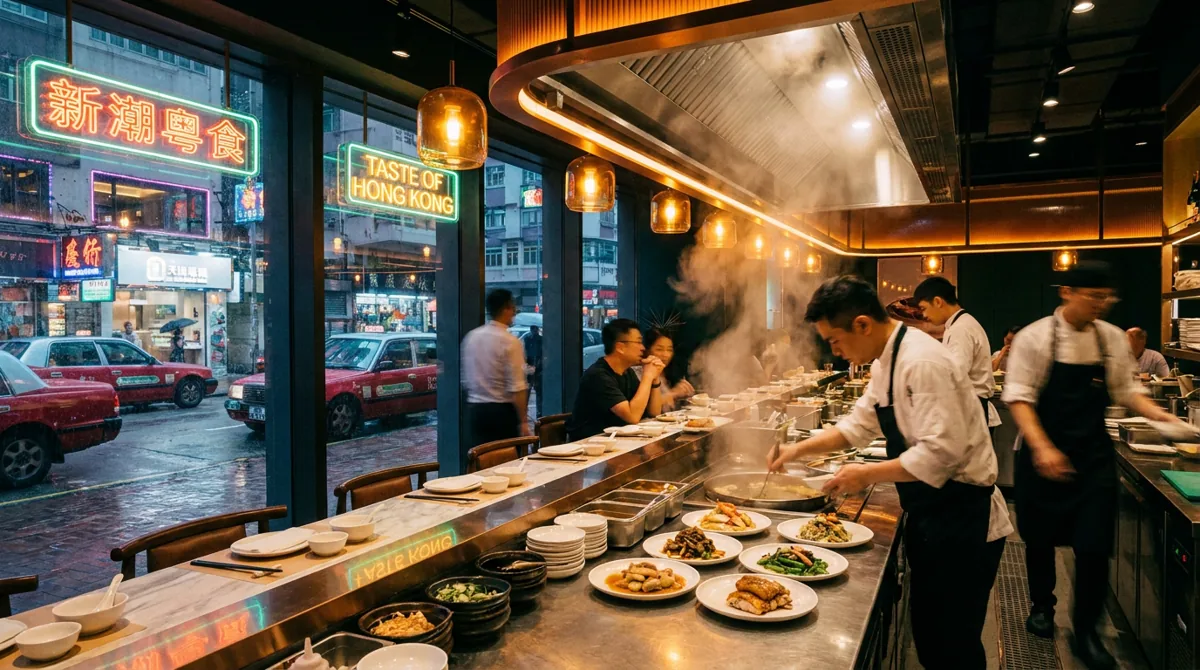
Turn off Nathan Road after dark, slip down a side street in Yau Ma Tei, and the city changes register. Red-and-white awnings, the hiss of a wok, fortune tellers under bare bulbs, a stranger belting out Cantonese opera to a deckchair crowd — this is Temple Street Night Market (廟街), Hong Kong's most famous night out that costs nothing to walk into. It is loud, a little chaotic and gloriously old-school, and on a warm summer evening there is nowhere I would rather take a first-time visitor.
In This Guide
- Where is Temple Street Night Market — and why now?
- Getting there: the MTR, in plain English
- What can you do at Temple Street Night Market?
- Eat your way down the street
- Have your fortune told
- Catch the Cantonese opera
- Shop, browse and haggle
- Tin Hau Temple & the Jade Market
- When should you go in 2026?
- Is Temple Street still worth it?
- FAQ
Where is Temple Street Night Market — and why now?
The Temple Street Night Market spreads along Temple Street in the heart of Kowloon, threading through Yau Ma Tei (油麻地) and down into Jordan (佐敦). By day it is an ordinary, slightly tatty city street. By night the traffic is cleared and the stalls go up, turning roughly the stretch between Jordan Road and Kansu Street into a pedestrian river of food, fortune and bargains. Locals long ago nicknamed it "Men's Street" (男人街), a hangover from the days when its stalls leaned towards menswear, lighters and watches.
There is a reason it is having a moment again. After the quiet pandemic years, a 2023 government-backed revamp under the Night Vibes Hong Kong (夜繽紛) campaign relaunched the market with a refreshed look, themed food zones and subsidised street performances. Visitors came back in force. The market is busy, photogenic and firmly back on the tourist map — which makes 2026 a good year to see it, ideally before the crowds thicken later in the evening.
It belongs to a wider family of after-dark markets across the harbour. If you catch the bug, our guide to the Sham Shui Po night market covers the grittier, more local cousin a few MTR stops north, while the best markets in Hong Kong rounds up the lot, day and night.
Temple Street Night Market
Official market overview and access on the Hong Kong Tourism Board.
Getting there: the MTR, in plain English
This is the easy part. Temple Street sits between two MTR stations on the Tsuen Wan line, so you can arrive at one end and simply walk out the other. For the southern, Jordan end, leave Jordan Station from Exit A and walk west to Temple Street — about two minutes. For the northern, temple end and the fortune tellers, use Yau Ma Tei Station, Exit C.
My advice: start at Jordan and drift north. You will warm up with the goods stalls and snack vendors, hit the open-air restaurants in the middle, then finish among the fortune tellers and opera singers near the Tin Hau Temple — a natural crescendo. It is flat, well-lit and busy, which makes it one of the most beginner-friendly nights out in the city. Plenty more sit in our first-timer's guide to Hong Kong.
What can you do at Temple Street Night Market?
Temple Street is really four experiences stacked on one street: eating, fortune-telling, opera and shopping. You do not need a plan — half the fun is drifting — but knowing what is on offer helps you spend your evening (and your appetite) wisely. Here is how to make the most of each.
Eat your way down the street
Come hungry. The cheapest thrills are the snack stalls: curry fish balls (咖喱魚蛋) on a stick from around HK$15–25, crispy-edged egg waffles (雞蛋仔), stinky tofu for the brave, and grilled skewers. Then graduate to a sit-down feast at the cluster of open-air seafood and claypot rice (煲仔飯) restaurants towards the Yau Ma Tei end, where typhoon-shelter spicy crab (避風塘炒蟹) and clams in black-bean sauce arrive with paper tablecloths and cold beer.
Prices at the sit-down spots are higher than the snack stalls and vary by the seasonal market rate for seafood, so glance at the menu before you order. For a taste of old Hong Kong away from the woks, duck into Mido Café (美都餐室), a 1950s bing sutt on the corner of Public Square Street with stained glass, green tiles and a famous baked pork-chop rice. It is more a daytime-into-early-evening institution than a night-market stall, so swing by before the food crowds peak. It is also the perfect primer for our guide to the city's best cha chaan teng, and the wider world of Hong Kong street food.
Mido Café (美都餐室)
Have your fortune told
Near the temple end, the market narrows into a row of fortune tellers — palm readers, face readers, Chinese astrologers and the odd fortune-telling bird. It is one of the last places in modern Hong Kong where this trade still thrives in the open, and many readers speak enough English to walk a curious tourist through their fate. Expect to pay roughly HK$50–100 and up depending on the reading; always agree the price first, before the cards come out.
Catch the Cantonese opera
Stay for the soundtrack. On many evenings, amateur singers set up near the Tin Hau Temple and perform Cantonese opera (粵劇) and old Canto-pop standards to a gathering of plastic stools, hats out for tips. It is raw, unpolished and utterly local — performances are informal rather than scheduled, so treat them as a happy accident rather than a fixed showtime. Drop a few coins if you linger.
Shop, browse and haggle
The goods stalls are pure browsing theatre: watches, phone cases, T-shirts, jade trinkets, "vintage" lighters, Mao memorabilia, knock-off football shirts and souvenirs by the crate. Quality is hit-and-miss and the genuine-article claims should be taken with a fistful of salt, but as a place to hunt a cheap gift it is hard to beat. Haggling is expected: ask the price, offer well below, and be ready to walk — the walk is your best bargaining chip.
Tin Hau Temple & the Jade Market
Two daytime sights bookend the night market and reward an earlier start. Set just off Temple Street on Public Square Street, the Yau Ma Tei Tin Hau Temple (油麻地天后廟) is a calm, incense-wreathed complex dedicated to the sea goddess Tin Hau — a historic, much-loved temple complex and the spiritual anchor the whole street is named after. Entry is free; it keeps daytime hours and closes well before the market peaks.
A short walk away on Kansu Street, the covered Jade Market (玉器市場) packs in scores of stalls trading jade bangles, pendants and curios. It is a daytime affair, so pair it with the temple in the late afternoon, then roll straight into the night market as the sun drops. Unless you really know your jade, treat it as browsing rather than serious investment — and, yes, haggle here too.
Tin Hau Temple & Jade Market
When should you go in 2026?
Timing makes or breaks a Temple Street visit. Stalls start opening from around 2pm, but the market is half-asleep in daylight. The magic switches on after dark, with the peak roughly 7pm to 11pm, when food, fortune and song are all running at once. Get there too late and you will watch vendors packing up around midnight.
Summer adds a Hong Kong wrinkle. Evenings in June to September are hot and humid, and this is typhoon season — a raised storm signal or a black-rainstorm warning will thin the stalls fast. Dress light, carry water, and check the Hong Kong Observatory before you set off. A clear, dry evening is the one you want.
| Time of day | What it's like | Verdict |
|---|---|---|
| Afternoon (2–6pm) | Stalls setting up; quiet, hot, half-empty | Do the temple & Jade Market instead |
| Early evening (6–7pm) | Food stalls firing up; cooler, fewer crowds | Good for an unhurried dinner |
| Prime time (7–11pm) | Full swing — food, fortune tellers, opera | The sweet spot |
| Late (11pm–midnight) | Winding down; stalls closing | Last orders — don't dawdle |
Hours are a guide and shift with weather and trade. Check the Hong Kong Observatory for storm signals in summer, and confirm individual venue hours before a special trip.
Is Temple Street still worth it?
Honestly? Yes — with eyes open. The 2023 makeover that brought the buzz back has also smoothed some of Temple Street's rough edges, and you will hear longtime locals grumble that it feels a touch more staged than the anything-goes market they remember. There is truth in that. The genuine-antique claims are mostly theatre, and a few stalls lean hard on the tourist trade.
But weigh it fairly. Where else can you eat curry fish balls, have your palm read, hear live Cantonese opera and barter for a jade trinket inside the same hot, humming hour — for the price of a snack? As a window into old Kowloon and a brilliant first night out, Temple Street still delivers. Go for the food and the atmosphere, keep your bargaining wits about you, and you will have a ball.
How to do Temple Street like a local
- Arrive around 7pm — cooler air, full stalls, before the deepest crowds.
- Walk Jordan → Yau Ma Tei, ending at the fortune tellers and opera by the temple.
- Snack, then sit: fish balls and egg waffles first, claypot rice or crab after.
- Agree every price first — for readings, seafood by weight, and any "antique".
- Haggle on goods, not food; offer low, smile, and be ready to walk away.
- Carry small cash — many stalls and the heritage café are cash-friendly.
- Check the weather in summer; a storm signal empties the street.
Make a fuller evening of it with our pick of the best things to do in Hong Kong this week, or keep the street-food theme running across town.
Frequently Asked Questions
Take the Night Off
Pick a clear, warm evening, ride to Jordan and let Temple Street do the rest — then let YumChaNow keep you ahead of Hong Kong's best food, markets and things to do.