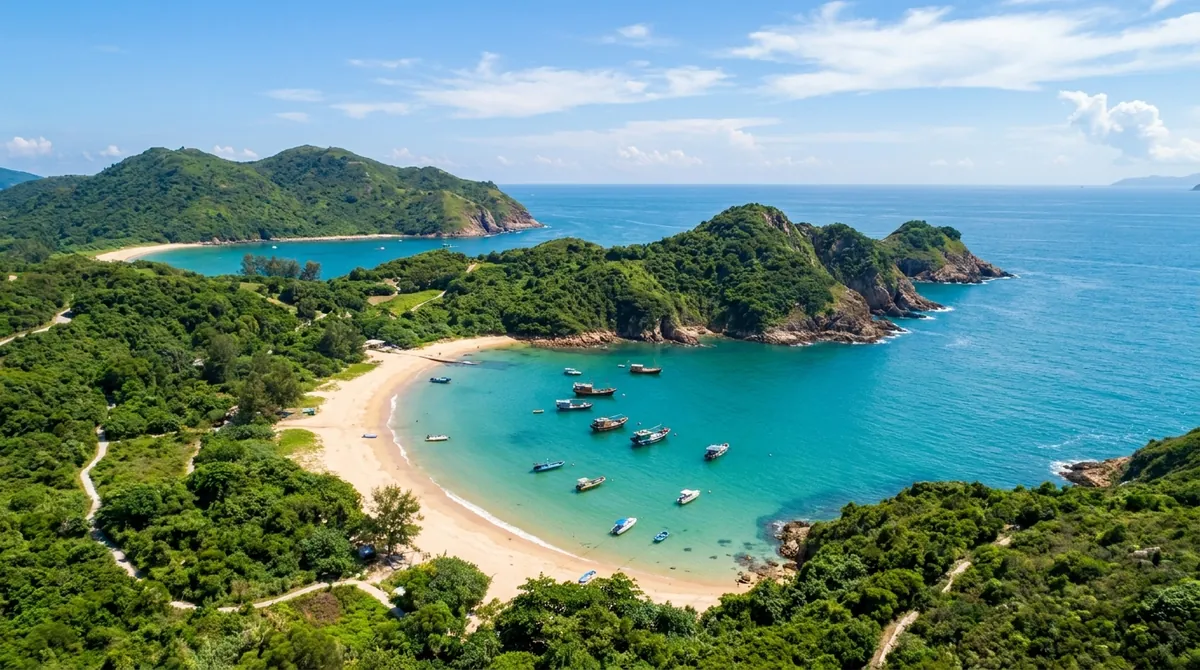
Illustration: Yum Cha Now, AI-generated. It sets the scene and is not a photograph of the venue.
Step off the ferry at Cheung Chau (長洲) and the city falls away. There are no cars, no malls and no roar of traffic, just bicycles, the clatter of mahjong tiles, fishing boats bobbing in the typhoon shelter and the smell of grilling seafood drifting off the praya. A Cheung Chau day trip is the easiest way to swap the skyline for sand and salt air, and on a warm 2026 summer's day it is the escape half of Hong Kong is quietly planning too.
In This Guide
- Where is Cheung Chau, and why go now?
- Getting there: the ferry from Central
- Beaches & windsurfing: Tung Wan and Kwun Yam Wan
- Pak Tai Temple & the pirate's cave
- Walk the Mini Great Wall
- What should you eat on Cheung Chau?
- The Bun Festival: the island's wildest day
- When is the best time to go in 2026?
- Your perfect Cheung Chau day trip: a sample plan
- FAQ
Where is Cheung Chau, and why go now?
Cheung Chau (長洲) is a small, dumbbell-shaped island in Hong Kong's Islands District, sitting in the sea southwest of Hong Kong Island. The name means "long island", and at its narrow waist the whole place is barely a few hundred metres across. You can stroll from the harbour on the west side to the main beach on the east in under ten minutes. It remains a working fishing community, with a busy typhoon shelter full of sampans and trawlers.
The big draw is what Cheung Chau does not have: cars. The island is car-free, so the lanes belong to pedestrians, bicycles and the odd mini fire-truck. That gives it an unhurried, village rhythm you simply cannot find on Hong Kong Island. Summer is peak season, when the beaches open up and the seafood terraces stay busy past sunset, which makes 2026 a fine year to go. It is one of Hong Kong's best islands and a classic among the best day trips from Hong Kong.
Getting there: the ferry from Central
Reaching Cheung Chau is half the fun, and genuinely simple. Sun Ferry (新渡輪) runs the route from Central Pier No. 5, a short walk from Hong Kong Station and the Central waterfront. You have two choices: the slower, cheaper ordinary ferry (around 55–60 minutes), with an open-air upper deck that is lovely on a clear day, or the air-conditioned fast ferry (around 35–40 minutes).
Fares are modest and you can simply tap an Octopus card at the gate. Following a fare adjustment on 1 April 2026, a one-way adult ordinary ferry costs from about HK$16.70 on weekdays, rising on Sundays, public holidays and for the fast ferry. Boats run frequently from early morning until late at night, but sailings around weekend middays fill up: arrive ten minutes early for a good seat. Always check the latest times and prices on the official Sun Ferry timetable before you set off.
The Cheung Chau Ferry
Fares and times change: confirm on the Sun Ferry site. New to the city? Start with our first-timer's guide to Hong Kong.
Beaches & windsurfing: Tung Wan and Kwun Yam Wan
Cheung Chau's two main beaches sit back-to-back on the eastern side of the island, a flat five-to-ten minute walk across the waist from the ferry pier. Tung Wan (東灣) is the longest and most popular: a wide, gently shelving strip of sand with showers, changing rooms and, in the swimming season, lifeguards and a shark-net swimming zone. It is the obvious spot to lay a towel and cool off.
Just around the headland to the south is smaller Kwun Yam Wan (觀音灣), and this is where the island earns its place in Hong Kong sporting history. Kwun Yam Wan is the home of the long-running Cheung Chau Windsurfing Centre, where local girl Lee Lai-shan (李麗珊) — affectionately known as "San San" — learned to ride a board. In 1996 she won the women's windsurfing gold in Atlanta, becoming Hong Kong's first-ever Olympic gold medallist — and still its only one from the British-colonial era. You can still hire windsurf boards, kayaks and stand-up paddleboards here and grab a drink at the café. For more on getting out on the water, see our guide to the best watersports in Hong Kong.
Tung Wan & Kwun Yam Wan Beaches
If hunting out quieter sand is your thing, the island rewards a wander, and our round-up of secret beaches near Hong Kong has more coves worth the ferry ride.
Pak Tai Temple & the pirate's cave
Cheung Chau's history runs deep, and two sights tell it best. A few minutes' walk up from the harbour stands the Pak Tai Temple (玉虛宮), built in 1783 and dedicated to Pak Tai, the Taoist sea god the island's fisherfolk credit with ending a deadly 18th-century plague. Now a declared Grade 1 historic building, it is free to enter and is the spiritual heart of the island, and the focal point of the annual Bun Festival. Step inside to see the incense-wreathed main hall and the temple's antique relics.
For something racier, head to the island's southwestern tip and the Cheung Po Tsai Cave (張保仔洞), said to be the hideout of the early-19th-century pirate Cheung Po Tsai, who once commanded a fleet of hundreds of junks. It is less a grand cavern than a narrow rocky cleft, you squeeze in one side and out the other in about five minutes, but the legend of buried treasure makes it a fun stop. Bring a torch or use your phone light, and wear shoes with grip. You can reach this corner on foot via the coastal Family Walk or by a short, cheap kaito (sampan) hop from the praya.
Pak Tai Temple & Cheung Po Tsai Cave
Walk the Mini Great Wall
The island's best easy walk is the Mini Great Wall (小長城), a paved path that snakes along the rocky eastern headland beyond Kwun Yam Wan. Railed walkways and stone pavilions thread between weather-sculpted granite boulders, several of which have earned nicknames: look for the so-called Human Head Rock and Vase Rock. The sea views are wonderful, and the full loop takes about an hour at a gentle pace.
It is mostly flat and well-marked, which makes it doable in trainers, but there is little shade: a sunhat and water are essential in summer. If you catch the walking bug, our guide to the best hikes in Hong Kong maps out longer trails across the territory once you are back on the big island.
What should you eat on Cheung Chau?
Come hungry: eating is one of the great pleasures of a Cheung Chau day trip. The island is built on fishing, so fresh seafood is the headline act. The praya (海傍街), the waterfront strip either side of the ferry pier, is lined with open-air restaurants where you point at the tanks: steamed garoupa, salt-and-pepper squid, stir-fried clams in black-bean sauce and prawns straight off the boats. Prices follow the daily market rate, so glance at the board before you order.
For snacking on the move, Cheung Chau has a few legends. The giant fish balls (大魚蛋) on skewers are the size of golf balls, doused in curry sauce; the mango mochi (芒果糯米糍), soft glutinous-rice parcels stuffed with fresh mango and cream, are the island's sweet signature. And don't leave without a "peace bun" (平安包), the steamed white bun stamped with the lucky character 平安 (peace), a souvenir of the Bun Festival that island bakeries sell all year round. It all sits firmly within the wider world of Hong Kong street food.
The Bun Festival: the island's wildest day
Once a year, sleepy Cheung Chau erupts. The Cheung Chau Bun Festival (太平清醮) is a centuries-old Taoist rite of thanksgiving and protection, recognised as part of China's national intangible cultural heritage. Giant bamboo towers studded with thousands of lucky buns rise outside the Pak Tai Temple, costumed children appear to "float" above the crowds in the famous Piu Sik (floating colours) parade, and the whole island turns vegetarian for the duration, even the local McDonald's swaps to mushroom burgers.
The climax is the midnight bun-scrambling race, where climbers scale a 14-metre tower to grab as many buns as they can. In 2026 the festival ran from 21 to 25 May, with the parade on 24 May (Buddha's Birthday) and the bun-scrambling final late on 25 May, so this year's has already passed. Because the dates follow the lunar calendar, expect the next one around the same time in spring 2027. Plan ahead: ferries are jammed and the island is shoulder-to-shoulder on the big days. For festival specifics each year, the Hong Kong Tourism Board keeps the official details.
When is the best time to go in 2026?
For beaches and watersports, summer (June to September) is prime time: the sea is warm and the island is at its liveliest. The trade-off is Hong Kong's heat, humidity and, crucially, typhoon season. A raised storm signal or a black rainstorm warning can suspend ferries at short notice and shut the beaches, so a flexible, clear-sky day is the one to pick.
Spring and autumn are gentler for walking the Mini Great Wall and the coastal trails. Whenever you go, set off in the morning: you will dodge the worst of the midday sun and beat the weekend ferry crush. Always check the Hong Kong Observatory before you travel in summer.
Summer Safety: Mind the Weather
June to September is typhoon and rainstorm season. Ferries can be cancelled when Typhoon Signal No. 8 or a Black Rainstorm Warning is hoisted, and you do not want to be stranded. Check the Hong Kong Observatory the morning you travel, carry water and sun protection, and only swim within the netted, lifeguarded zones during the gazetted swimming season.
| Season | What it's like | Best for |
|---|---|---|
| Summer (Jun–Sep) | Hot, humid, lively; typhoon risk | Beaches, swimming, watersports |
| Autumn (Oct–Nov) | Warm, drier, clear skies | Walking the Mini Great Wall & coast |
| Spring (Mar–May) | Mild; the Bun Festival lands here | Festival atmosphere (book ahead) |
| Winter (Dec–Feb) | Cooler, quiet; too cold to swim | Seafood lunches & temple visits |
Seasons are a guide; check the Hong Kong Observatory for storm signals and confirm ferry times before any special trip.
Your perfect Cheung Chau day trip: a sample plan
Not sure how to slot it together? Here is an easy, unhurried way to spend a full day on the island, with no car and no stress.
One relaxed day on Cheung Chau
- Mid-morning: Catch the ferry from Central Pier 5; ride the open top deck across the harbour.
- On arrival: Stroll the praya, then walk up to Pak Tai Temple (玉虛宮).
- Late morning: Cross the island's waist to Tung Wan Beach for a swim.
- Lunch: Seafood on the praya, or grab giant fish balls and a mango mochi to go.
- Afternoon: Walk the Mini Great Wall, or sampan to the Cheung Po Tsai Cave.
- Late afternoon: Hire a kayak or board at Kwun Yam Wan, or just watch the boats.
- Early evening: An early seafood dinner, then a sunset ferry back to Central.
Pair it with more of the territory's outdoors in our pick of the best islands in Hong Kong, and you have a summer's worth of car-free escapes.
Frequently Asked Questions
Catch the Next Ferry
Pick a clear morning, ride out to Cheung Chau and let the island do the rest. Then let YumChaNow keep you ahead of Hong Kong's best islands, beaches and things to do.