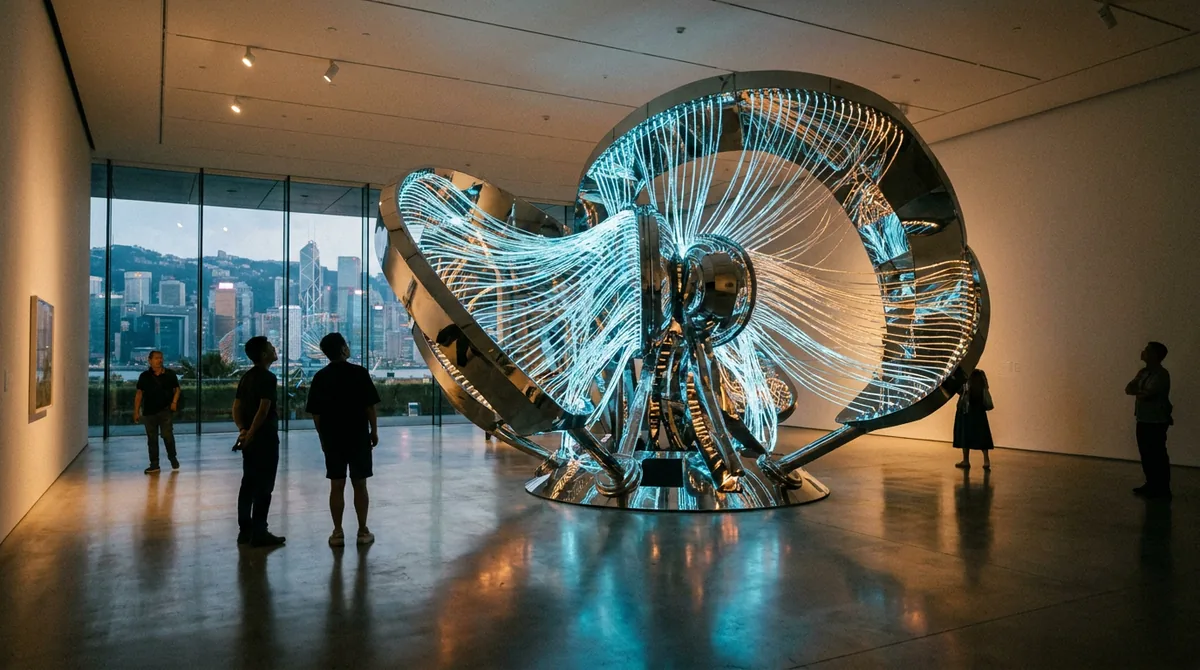
Illustration: Yum Cha Now, AI-generated. It sets the scene and is not a photograph of the venue.
Ryuichi Sakamoto spent half a century turning sound into something you could almost touch. Now, for free, you can walk inside it. At M+ in West Kowloon, the late Japanese composer's work fills a darkened gallery with image and music in "seeing sound, hearing time", and it is one of the most quietly moving things on in Hong Kong this summer. This is a music story that happens to live inside a museum, and here is exactly what to see before it closes.
In This Guide
Why a Sakamoto show at M+ matters
Hong Kong gets no shortage of big art. Between Art Basel, the painting blockbusters across the harbour and a relentless gallery calendar, a show has to do something different to stand out. A free exhibition built entirely around the work of one of the most influential musicians of the last fifty years does exactly that.
Ryuichi Sakamoto was a composer before he was anything else, but his work never sat still inside one discipline. This show, presented by M+, treats him as an artist whose ideas about sound spilled out into image, film and space. As M+ Museum Director Suhanya Raffel put it, his "interdisciplinary practice encompassing sound, image, performance, and film has had a profound impact on music and art worldwide." That is the rare crossover that pulls in gig-goers and gallery regulars in the same queue.
The timing helps. This is a free, air-conditioned, genuinely beautiful thing to do in the thick of a sticky Hong Kong summer: an easy beat-the-heat afternoon that happens to put you inside the work of a true original. If you are mapping out the season, it slots neatly alongside the city's other free draws and the wider best art exhibitions in Hong Kong this summer.
Who was Ryuichi Sakamoto?
If you know one Sakamoto fact, it is probably the Oscar. He won the Academy Award for Best Original Score for Bernardo Bertolucci's The Last Emperor (1987), shared with David Byrne and Cong Su: along with a Golden Globe and a Grammy for the same film. But that is only one corner of the story.
Born in Tokyo in 1952, Sakamoto first broke through as a co-founder of Yellow Magic Orchestra, the Japanese trio whose late-1970s electronic pop helped lay the groundwork for techno, hip-hop and synth music worldwide. From there he scored films: Merry Christmas, Mr. Lawrence (1983), in which he also acted opposite David Bowie, and Alejandro González Iñárritu's The Revenant (2015), and kept pushing into quieter, more experimental territory. His 2017 album async, made after a cancer diagnosis, is the emotional core of this exhibition. He died in March 2023, aged 71.
That range is why a nightlife-and-music writer can happily send you to a museum for the afternoon: Sakamoto's fingerprints are on the electronic music that still fills Hong Kong's clubs and concert halls. For the louder end of the spectrum, see our round-up of the best live music and concerts in Hong Kong.
What you'll actually see
The show is anchored by one major work, with a few carefully chosen companions. Here is what is waiting for you.
1. async–immersion: the centrepiece
The reason to come. async–immersion (2023) is a large-scale installation Sakamoto created with the artist Shiro Takatani, part of their ongoing "installation music" series. Inside a darkened room in The Studio on Level B2, a roughly 18-metre LED wall shows Takatani's footage of Sakamoto's piano, books, percussion and objects from his New York studio dissolving into shimmering horizontal lines, set to the surround-sound playback of async. Takatani completed the piece after Sakamoto's death, which gives it the feel of a farewell as much as a concert.
2. Nam June Paik: All Star Video
In the Found Space on Level B2 sits All Star Video (1984) by the Korean video-art pioneer Nam June Paik, a friend and collaborator of a young Sakamoto. It is a window onto the buzzing 1980s New York art scene that shaped him, with cameos from the likes of Laurie Anderson and John Cage.
3. Carsten Nicolai on the Grand Stair
On the Grand Stair at ground level, the German artist-musician Carsten Nicolai (who records as Alva Noto and collaborated with Sakamoto for years) shows two recent moving-image works, ENDO EXO and PHOSPHENES, both scored from Sakamoto's final album, 12. They run a little longer than the main show, so you can still catch them if you arrive late in the run.
Beyond the galleries, M+ has been running a season of Sakamoto film screenings and record-listening sessions in its cinema and Moving Image Centre. Programmes change, so check the official M+ page for what is on the week you visit. If you like a single-artist deep dive, pair this with the Lee Bul show at M+ in the same building.
Is the Ryuichi Sakamoto exhibition at M+ free?
Yes, and that genuinely is the headline. Seeing sound, hearing time is presented free of charge in The Studio on Level B2, so you do not need a ticket to see the Sakamoto installation. M+ ticket holders, members and patrons get priority-lane access when it is busy, but entry to this show costs nothing.
One honest caveat on the dates. The exhibition opened on 14 February 2026, and when it launched M+ announced a closing date of 5 July. The museum's live exhibition page now lists 12 July 2026 — in other words, it looks to have been extended by a week. Because the museum's own pages have shown both dates, treat 12 July as the likely close but confirm on the official page before a July visit. Here are the verified essentials.
| Detail | Information |
|---|---|
| Exhibition | Ryuichi Sakamoto | seeing sound, hearing time (坂本龍一 | 觀音・聽時) |
| Dates | 14 February – 12 July 2026 (extended from 5 July) |
| Venue | The Studio, Level B2 (with works on the Grand Stair, G) |
| Admission | Free |
| Star work | async–immersion (2023), with Shiro Takatani |
M+: Visitor Essentials
Note: last admission is 30 minutes before closing. Hours and the closing date can change: confirm on the official M+ exhibition page before you travel.
Because B2, the Found Space and the Grand Stair are free zones at M+, your trip costs nothing even before you factor in the harbour views from the museum's terraces. For more ideas in that vein, see our guide to the best free things to do in Hong Kong, or the free Monet show across the harbour at HKMoA.
How do you get to M+ in West Kowloon?
M+ sits on the waterfront of the West Kowloon Cultural District (西九文化區), and the easiest approach is by train. Take the MTR to Kowloon Station on the Tung Chung Line, then follow the signs through the ELEMENTS mall to West Kowloon: a walk of about 10 to 15 minutes from Exit C1, D1, E4 or E5. Austin Station on the Tuen Ma Line (Exit B4 or B5) is a similar walk through the same mall.
Prefer the scenic route? The West Kowloon Ferry crosses from Central Pier No. 9 to the WestK quay in under ten minutes, and at weekends a water taxi loops in from Tsim Sha Tsui East. Once you are there, M+ shares the district with the Hong Kong Palace Museum and the Art Park, so it is easy to build a half-day around it. Full transport options are listed on the M+ visitor page.
How to do it well
This is a low-key, atmospheric show rather than a blockbuster crush, but a little planning still pays off.
Visiting Tips
- Give the room time. async–immersion runs on a loop: settle in and watch a full cycle rather than passing through; the sound and image build slowly.
- It is dimly lit by design. The Studio is a dark, immersive space with low light and surround sound, so give your eyes a moment to adjust when you step in.
- Go on a weekday. M+ opens at 10am and Friday runs late to 10pm; weekday mornings and Friday evenings are the calmest windows.
- Mind the Monday closure. M+ is shut on Mondays, which catches a lot of visitors out.
- Photos yes, video mostly no. Still photography is fine without flash; video is generally not permitted unless signed otherwise, so check the gallery notices.
- Make a day of West Kowloon. The free B2 and Grand Stair works, the harbour terraces and the neighbouring museums all sit within a short walk.
Before You Go
This is a temporary exhibition. M+ now lists a closing date of 12 July 2026, extended from the 5 July date announced at launch, but because the museum's own pages have shown both, confirm the date on the official M+ page before a July visit. Entry is free and no booking is required, but M+ is closed on Mondays and last admission is 30 minutes before closing.
Making a cultural weekend of it? Our round-up of the biggest events in Hong Kong this summer has the wider calendar in one place, from gigs to festivals.
Frequently Asked Questions
See It Before It Closes
"Ryuichi Sakamoto | seeing sound, hearing time" is free, and M+ lists it as running only until 12 July 2026. Plan your visit, then let YumChaNow keep you ahead of the next big thing in town.