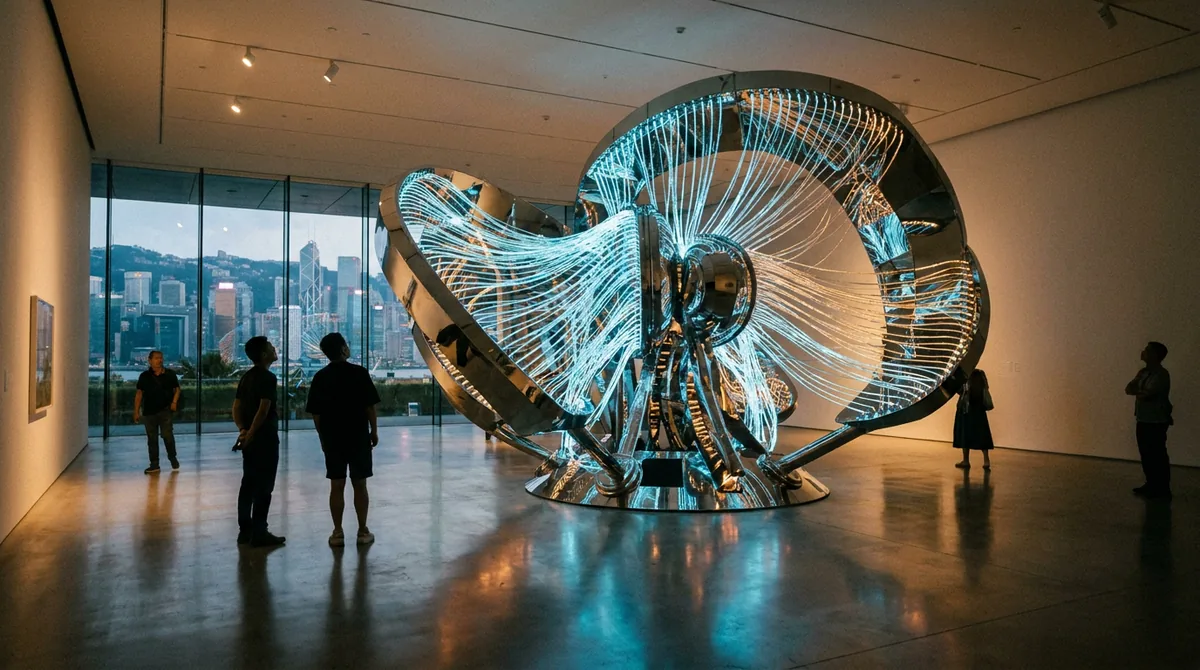
Illustration: Yum Cha Now, AI-generated. It sets the scene and is not a photograph of the venue.
When M+ opened in November 2021, it completed a transformation of Hong Kong's West Kowloon waterfront from reclaimed land into Asia's most ambitious cultural precinct. Four years on, the museum has found its stride: building a collection and exhibition programme that situates Hong Kong, China, and Asia in genuine dialogue with global contemporary culture. It is, without qualification, one of the world's great museums. If you haven't been recently, what follows will tell you why to go now.
In This Guide
Current Exhibitions: May 2026
Antony Gormley: Static
The British sculptor Antony Gormley's first major museum survey in Asia fills M+'s large galleries with work spanning four decades, from his early cast-iron body forms to the more recent spatial works that dissolve the boundary between sculpture and architecture. Static includes the Hong Kong premiere of his recent room-scale steel mesh works, which create the sensation of walking inside a thinking mind. The exhibition is enormous in ambition and largely delivers on it. Gormley's work takes patience; give it the time it asks for.
Moving Images: Hong Kong Cinema at the Turn of the Century
This exhibition examines Hong Kong cinema of the 1980s–2000s through objects, film stills, production design, and archival materials: the period when Hong Kong produced the most internationally influential body of genre cinema in Asia. The work of Wong Kar-wai, John Woo, Johnnie To, and Ann Hui is examined not as nostalgia but as serious cultural production that shaped global cinema. The accompanying screening programme at M+ Cinema presents rare prints and newly restored Hong Kong films throughout 2026.
Design & Architecture Galleries: Permanent Rotation
M+'s permanent collection galleries present approximately 1,500 works from a collection of over 8,000 items: the most significant collection of 20th and 21st century visual culture in Asia. The design and architecture wing is particularly strong, featuring original drawings and models by Hong Kong architects, industrial design from China and Japan, and the history of graphic design in post-war East Asia. The collection's depth in Gutai, avant-garde Chinese art, and contemporary Southeast Asian practice gives M+ a research quality that distinguishes it from many Western peers.
The Permanent Collection: Key Highlights
M+'s collection policy has always prioritised depth over spectacle: the aim is to document visual culture from the Hong Kong region, from China, and from Asia, within a global framework. Some highlights of the permanent collection that rotate through the galleries:
Permanent Collection Highlights
| Work / Artist | Category | Why It Matters |
|---|---|---|
| Yayoi Kusama, Infinity Mirror Room | Contemporary Art | Kusama's iconic immersive installation; among the most photographed works in the museum |
| Ai Weiwei, Coloured Vases | Contemporary Chinese Art | Challenged assumptions about tradition and destruction; politically charged and visually powerful |
| Wong Kar-wai Archive | Moving Image | Production materials from In the Mood for Love and Chungking Express: the most important HK cinema archive in the world |
| Gutai Group Works | Post-War Japanese Art | Rare examples of Gutai action painting; M+ holds one of the strongest collections outside Japan |
| Zao Wou-Ki | Chinese-European Painting | Lyrical abstract canvases bridging East and West; deeply beautiful |
| Hong Kong Design History | Design & Architecture | The definitive archive of Hong Kong graphic design, including typography, signage, and commercial art |
The Building: Herzog & de Meuron
The M+ building is a major work of architecture in its own right. Herzog & de Meuron, who also designed Tate Modern in London and the Beijing National Stadium, collaborated with local architects TED Associates to produce a building that rises in an inverted T-shape from the West Kowloon waterfront. The above-ground tower contains the special exhibition galleries; below-ground galleries extend beneath the Victoria Harbour promenade.
The building's most spectacular feature is its LED facade facing the Hong Kong Island skyline — 65 metres tall and 110 metres wide, it is the largest programmable media facade in the world. At night, the facade displays commissioned artworks, and the effect of watching art projected at building scale across the harbour with the Central skyline behind is singular. The viewing lawn in front of the building is free to access and worth visiting even if you don't enter the museum.
The M+ Pavilion
Adjacent to the main building, the M+ Pavilion was the first completed structure in the West Kowloon Cultural District: a flexible, column-free space originally used for exhibition purposes while the main building was under construction. It now serves as a venue for performance, events, and temporary exhibitions, and is one of the most sought-after event spaces in Hong Kong. The Pavilion's terrace faces directly onto the harbour with views across to Central. It is used for outdoor screenings and events on selected evenings throughout the year.
Visitor Information
M+ Museum: Practical Visitor Details
| Detail | Information |
|---|---|
| Address | 38 Museum Drive, West Kowloon Cultural District, Kowloon |
| Chinese Name | M+博物館 |
| MTR | Kowloon Station (Tung Chung Line / Airport Express), Exit C1 or D1; 10–12 min walk following signage |
| Opening Hours | Tue–Sun 10:00–18:00; closed Mondays; last admission 17:30 |
| Admission | HKD 120 (adult); HKD 60 (student / senior / disabled); Under 18 free |
| Special Exhibitions | Separate ticket required; currently Antony Gormley: Static (HKD 180 incl. general admission) |
| Booking | mplus.org.hk: online booking recommended for weekends |
| Free Admission Days | First Sunday of each month; check website for schedule |
| Phone | +852 2200-0217 |
Eating Near M+
The M+ building has a café and a restaurant. The restaurant (The M+ Restaurant) is worth considering for lunch: a Hong Kong-biased menu in an interior with harbour views. For a more casual option, the ground-floor café serves pastries and coffee. The West Kowloon Cultural District waterfront promenade has multiple casual food options, and Elements Mall at Kowloon Station (a 12-minute walk) has a comprehensive food hall including excellent Japanese and Cantonese options.
Frequently Asked Questions
More Art in Hong Kong
Explore our guides to Best Art Galleries in Hong Kong 2026 and Wong Chuk Hang's Gallery District.