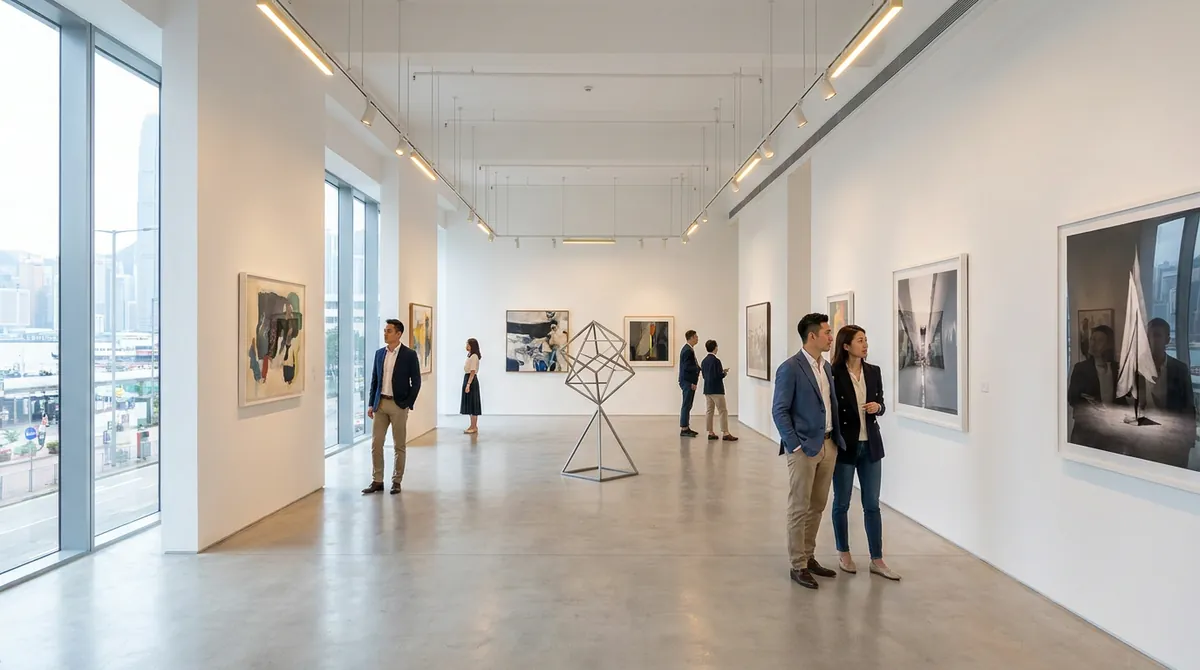
Illustration: Yum Cha Now, AI-generated. It sets the scene and is not a photograph of the venue.
Ten years ago, Wong Chuk Hang was a light industrial district on the southern end of Hong Kong Island: metal workshops, printing companies, car repair shops, the odd noodle factory. Then the MTR South Island Line opened in 2016, the galleries arrived, and the transformation of the neighbourhood into Hong Kong's de facto gallery quarter accelerated beyond anyone's expectations. By 2026, walking through Wong Chuk Hang on a Saturday afternoon feels like walking through a version of what London's Bermondsey was 20 years ago: serious international galleries operating in converted industrial buildings, a sense of cultural accumulation, an art world finding its geography.
In This Guide
International Gallery Heavyweights
Edouard Malingue Gallery
Edouard Malingue is the most significant Hong Kong-origin gallery operating in the international contemporary art market. Founded in 2010, it represents some of the most important contemporary Asian artists: Cheuk Wing Nam, Wilson Shieh, and international figures including Vija Celmins and Thomas Houseago. The WCH space is large and well-designed, giving the works the room to function at full scale. Their programme consistently includes both solo exhibitions and carefully assembled group shows that make productive arguments. This is a gallery for serious looking.
Massimo De Carlo Hong Kong
Massimo De Carlo, the Milan-origin gallery that represents some of the most commercially powerful artists in the contemporary art market, occupies a typically polished space in Wong Chuk Hang. The programme brings international blue-chip names (Ugo Rondinone, Franz West, Peter Wächtler) to Hong Kong audiences alongside a commitment to finding Asian positions within a global programme. The gallery's design aesthetic is that of a white cube done with Italian attention to proportion. Reliable, serious, occasionally brilliant.
Perrotin Hong Kong
Emmanuel Perrotin's Hong Kong space is one of the gallery's most active: the Paris-founded gallery has committed seriously to Asian artists and Hong Kong as a market, and the WCH space reflects that. Takashi Murakami, Paola Pivi, Daniel Arsham, and younger emerging Asian artists sit alongside each other in a programme that has breadth and intelligence. The gallery space is large and airy; the private viewing rooms are worth asking to see if you're a serious collector. During Art Basel week, Perrotin is always one of the busiest galleries in the district.
Pékin Fine Arts
Pékin Fine Arts began in Beijing and brought its Chinese contemporary art programme to Hong Kong's Wong Chuk Hang district with a consistent focus: serious contemporary Chinese art making, with particular attention to artists engaging with Chinese ink painting tradition in relation to contemporary practice. The gallery represents a number of mainland Chinese artists whose work deserves wider international attention, and their curatorial approach, placing tradition and rupture in careful dialogue, gives their shows a depth that purely market-driven galleries often lack.
Specialist & Independent Spaces
Blindspot Gallery
Blindspot Gallery is Hong Kong's leading photography-specialist gallery: a genuine rarity in a market dominated by painting and sculpture. The programme brings together documentary photography, conceptual photography, and photobook culture in a programme that takes the medium seriously. They represent Hong Kong photographers including Map Office and international figures whose work intersects documentary and fine art. Their annual photobook fair, held in autumn, is one of the most interesting small-scale art events in the city.
Empty Gallery
Empty Gallery is the most intellectually rigorous gallery in Wong Chuk Hang — a deliberately spare space presenting work that makes no concessions to the market. The gallery has championed artists including Liam Gillick, Ian Wallace, and Hong Kong-based practitioners whose work operates at the intersection of language, architecture, and institutional critique. Coming to Empty Gallery requires attention; the work demands it and rewards it. The programme is slow — four to five shows per year — and each one is considered rather than seasonal.
Suggested Walking Route: Wong Chuk Hang Gallery Day
Half-Day Gallery Walk: Wong Chuk Hang
| Stop | Gallery | Time |
|---|---|---|
| 1 | Exit Wong Chuk Hang Station (Exit B); walk south on Wong Chuk Hang Rd | 10:30am |
| 2 | Massimo De Carlo: One Island South (5 min from Exit B) | 10:40am |
| 3 | Perrotin: WCH location (3 min walk from De Carlo) | 11:15am |
| 4 | Pékin Fine Arts: follow gallery signage (10 min walk) | 11:50am |
| 5 | Lunch break — 1pm; various cafés and Japanese restaurants in the WCH industrial precinct | 1:00pm |
| 6 | Edouard Malingue — 33 Aberdeen St area (15 min walk or taxi) | 2:00pm |
| 7 | Empty Gallery or other independent spaces: ask at Malingue for current recommendations | 3:00pm |
| 8 | Return via MTR or walk to Aberdeen waterfront for seafood dinner | 4:30pm |
Full Gallery Directory: Wong Chuk Hang & Aberdeen 2026
Gallery Quick Reference
| Gallery | Focus | Hours |
|---|---|---|
| Edouard Malingue | Contemporary Asian & international | Tue–Sat 11am–7pm |
| Massimo De Carlo | International contemporary | Tue–Sat 10am–6pm |
| Perrotin | International + Asian contemporary | Tue–Sat 11am–7pm |
| Pékin Fine Arts | Contemporary Chinese | Tue–Sat 11am–6pm |
| Blindspot Gallery | Photography | Tue–Sat 11am–7pm |
| Empty Gallery | Conceptual, minimal | Tue–Sat 11am–6pm |
| PHD Group | Emerging Asian artists | Mon–Sat 11am–7pm |
| Simon Lee Gallery | International contemporary | Tue–Sat 11am–7pm |
Eating in Wong Chuk Hang
The Wong Chuk Hang industrial area has developed a strong food scene alongside its galleries. There are excellent Japanese restaurants (ramen, yakitori) in the One Island South building complex. For traditional Hong Kong eating, the noodle shops and char siu rice places on Wong Chuk Hang Road have barely changed with the neighbourhood's transformation and are all the better for it. Aberdeen waterfront, a 15-minute walk, has the best seafood restaurants in the area.
Frequently Asked Questions
More Art in Hong Kong
See our guides to Best Art Galleries Across Hong Kong and What's On at M+ Museum.