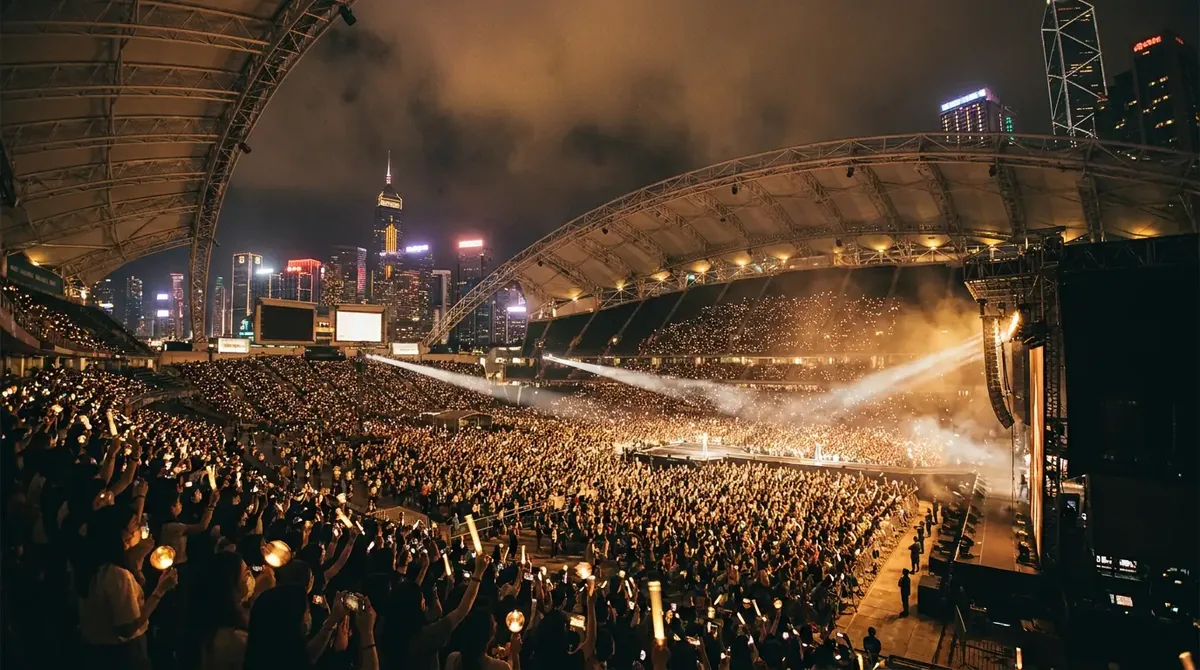
Illustration: Yum Cha Now, AI-generated. It sets the scene and is not a photograph of the venue.
Fifty years. The Cathay/HSBC Hong Kong Sevens has been running since 1976, when it was a modest eight-team tournament held at Hong Kong Football Club with a crowd that could fit in a decent-sized pub. What it has become — 12 men's teams, 12 women's teams, 50,000 people at a purpose-built stadium in Kowloon, three days of fast rugby and comprehensive fancy dress — is something that no one involved in that first edition could have predicted. There is no sporting event quite like it anywhere in the world.
50 Years of the Hong Kong Sevens
The first Hong Kong Sevens was held in 1976, organised by Ian Gow — a British businessman based in Hong Kong who had watched the Melrose Sevens in Scotland and thought: Hong Kong needs this. Eight teams, one day, a crowd of enthusiasts. It expanded to 16 teams by the 1980s and began attracting serious international competition. The famous South Stand — standing, raucous, costumed — became the event's cultural signature through the 1990s and 2000s.
For decades the tournament was held at Hong Kong Stadium in So Kon Po, Causeway Bay — a 40,000-seat bowl embedded in a residential hillside that created extraordinary atmosphere. The 2026 edition marked the first at the new Kai Tak Sports Park, a move that doubled the adjacent concourse space, added modern facilities, and connected the event directly to the MTR. The atmosphere question — whether a new, larger, more corporate venue could preserve what made the old ground special — was answered reasonably well, though the jury is still out on whether the South Stand culture fully transferred.
The 2026 Edition: Key Facts
Cathay/HSBC Hong Kong Sevens 2026
Tickets and Prices
Ticket purchasing is handled directly through hksevens.com: the official channel operated by the Hong Kong Rugby Union. Do not buy from secondary market sellers at face value or above unless you've exhausted official channels; resale platforms frequently overcharge. Authorised travel packages (including accommodation) are also listed on the official site for international visitors.
2026 Ticket Pricing
| Ticket Type | Adult | Child (12 & under) |
|---|---|---|
| 3-Day General Admission | HKD 2,250 | HKD 1,100 |
| Friday (Day 1) only | HKD 550 | HKD 300 |
| Saturday (Day 2) only | HKD 1,250 | HKD 625 |
| Sunday (Day 3) only | HKD 1,250 | HKD 625 |
The value play is the 3-day pass if you're attending more than one day. Friday is quieter and cheaper: first-round pool matches, good atmosphere, shorter queues for everything. Saturday is when serious rugby happens: pool finals, quarter-finals, and the stands are at their fullest. Sunday hosts the semi-finals and finals: the best rugby of the weekend but also the longest day. Most serious rugby fans I know prefer Saturday.
Kai Tak Sports Park
The move from Hong Kong Stadium to Kai Tak Sports Park is the biggest structural change to the Sevens since the tournament went professional. Kai Tak is a purpose-built 50,000-seat stadium on the old airport site in Kowloon: Time magazine named it one of the World's Greatest Places in 2026. The advantages are obvious: more space, better sightlines, direct MTR access (Kai Tak Station is on the Tuen Ma Line), modern F&B facilities, and improved accessibility throughout.
The Tuen Ma Line from Hung Hom to Kai Tak takes about 10 minutes from Hung Hom (connecting easily from Hong Kong Island via the East Rail Line). From Central, budget 25–30 minutes total. Given the 50,000-person capacity, transport infrastructure is considerably improved over the old Hong Kong Stadium arrangement, where post-match pedestrian crush on the So Kon Po hill was legendary.
How to Watch the Rugby Intelligently
Sevens rugby is structurally simple: seven players per side, two seven-minute halves, with a two-minute break. The scoring is identical to fifteens (try = 5 points, conversion = 2), but the pace is dramatically higher: sevens is essentially fifteens with most of the set-pieces removed and all the space amplified. Games are quick, explosive, and decided by a combination of physical pace and ball-handling skill that is unlike anything in fifteens.
Teams Worth Watching in 2026
The traditional powers in men's sevens are Fiji (whose players are born to the format: watch them against anyone and the technical superiority is startling), South Africa (powerful and fast), New Zealand (reliable, organised, deadly from set pieces), and Argentina. The women's competition has been increasingly dominated by New Zealand's Black Ferns Sevens and Australia, with France and the USA providing the strongest challenges.
The Hong Kong men's team competes as the host nation. They are not expected to progress beyond the pool stage against the world's best, but they compete hard and the local crowd support is genuine and enthusiastic: one of the more affecting moments of the weekend is watching a sold-out Hong Kong stadium cheer a local try.
Sevens Format Guide
| Day | Matches | Best For |
|---|---|---|
| Friday | Pool Stage (all groups playing first matches) | First look at every team; relaxed atmosphere; cheaper entry |
| Saturday | Pool Stage (second + third pool matches); Quarter-Finals | Best day overall: decisive pool matches and quarter-finals |
| Sunday | Semi-Finals; Bowl/Plate/Cup Finals; Women's Finals | Best rugby; highest drama; longer day but the payoff is there |
The Costume Culture
The fancy dress tradition at the Hong Kong Sevens is not optional. It started organically in the 1980s with expatriate crowds, became institutionalised through the 1990s, and is now as much a part of the event's identity as the rugby itself. Groups coordinate themes months in advance. The more elaborate, the better. The classic moves (superheroes, Where's Wally armies, inflatable dinosaurs, decades-specific characters) still work, but the teams putting in genuine creative effort stand out.
Practical advice: costumes need to be wearable for 12+ hours in April heat and humidity. Whatever you plan, test it in Hong Kong weather before the event. Anything that restricts vision, prevents drinking, or falls apart when wet is going to be a problem by the afternoon session. The best costumes over the years have been inventive, recognisable from 50 metres, and structurally sound enough to survive a full day of enthusiastic wear.
Food and Drink at the Ground
The F&B offering at Kai Tak has improved substantially over the Hong Kong Stadium days. Multiple concourse bars and food stations are distributed around the stadium: queues are shorter and better managed than they were at the old ground. Beer (Heineken, local lagers) is the primary beverage; spirits are available but at festival-standard pricing. Cash and Octopus card work; contactless card payment is available at most stands.
The practical approach: eat a proper meal before entering (there are excellent food options around Kowloon City and the Kai Tak precinct) and use the stadium catering for drinks and snacks between matches. Budget HKD 200–400 per person per day for drinks and light food inside the venue.
After-Parties and the Sevens Social Circuit
The Hong Kong Sevens has an extensive after-party circuit that extends across Wan Chai, Lan Kwai Fong, and TST. Wan Chai, historically the expat bar district, remains the primary post-game destination. Bars along Lockhart Road and the surrounding streets extend into the early hours during Sevens weekend, with many putting on themed events and late-night live music.
The key logistic: getting from Kai Tak to Wan Chai post-match is not instantaneous. The MTR from Kai Tak to either Wan Chai (via a change at Hung Hom or Admiralty) takes 30–45 minutes. Taxis outside the stadium after final matches are predictably scarce. Build this into your timing: the best strategy is to decide between staying for every last final (and accepting a later, more difficult journey) or leaving 20 minutes before the final whistle to beat the exit rush.
For nightlife options during Sevens weekend, see our guide to hidden bars and speakeasies and the best nightclubs in Hong Kong.
Where to Stay
Hotel rates across Hong Kong spike during Sevens weekend: book as far in advance as possible, ideally three months ahead. For location, TST and Kowloon hotels are now the best base given the switch to Kai Tak. For central Hong Kong Island accommodation see our boutique hotels guide and staycation hotels guide. The Harbourview in Wan Chai (if you're committed to the post-game Wan Chai circuit) or hotels in Kowloon Bay/Kowloon City (close to Kai Tak) are the most logical options if you're booking late.
Frequently Asked Questions
More Hong Kong sport and events
Check out our guide to Happy Valley Horse Racing: another uniquely Hong Kong sporting and social experience worth planning around.