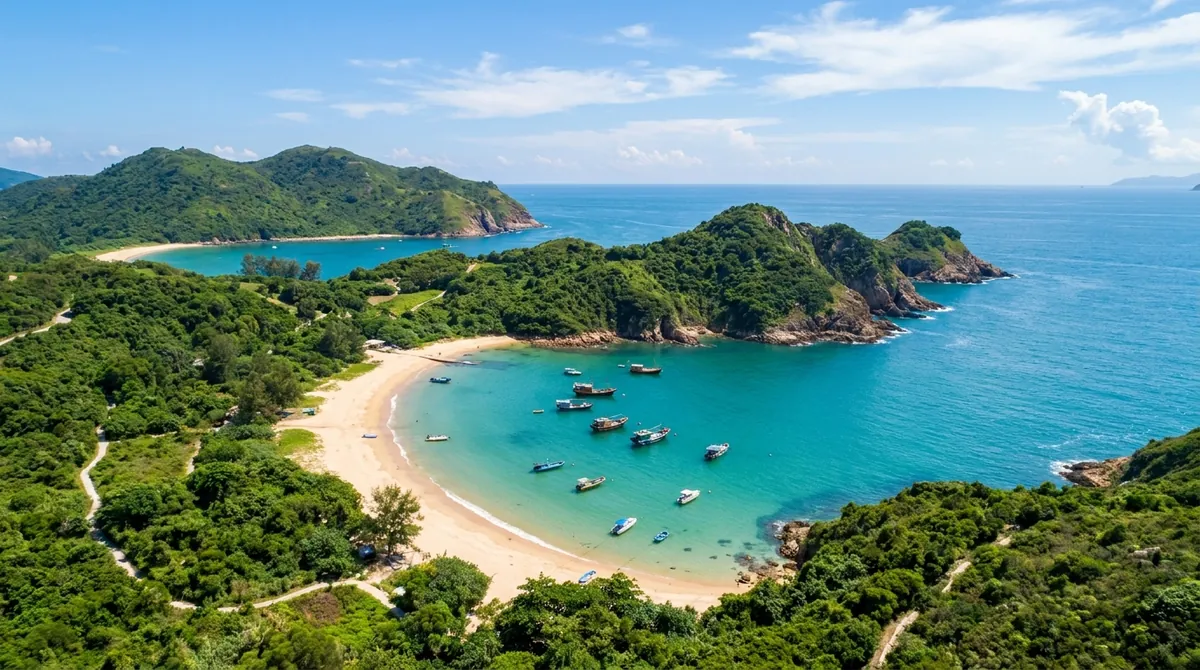
Illustration: Yum Cha Now, AI-generated. It sets the scene and is not a photograph of the venue.
Most people's first minutes in Hong Kong go the same way: out of the Airport Express at Central station, up to street level, and then a full stop for about thirty seconds. The density is overwhelming: skyscrapers stacked up a near-vertical hillside, trams rattling down a canyon of shopfronts, the smell of char siu and car exhaust and something that just smells like possibility. People who have lived here for a decade say they still feel it occasionally.
Hong Kong does that. No city announces itself quite so emphatically. And no city rewards a first-time visitor so richly, if they know what they're doing. This guide is the one I wish someone had handed me the day I landed. It covers everything: getting here, getting around, the neighbourhoods, the food, the essential experiences, and the practical details that make a trip run smoothly.
In This Guide
Getting There: Flights and Entry
Hong Kong International Airport (HKIA) is one of the world's busiest airports and is superbly connected. Cathay Pacific is the dominant carrier and operates an extensive global network from Hong Kong; budget carriers like HK Express fly Southeast Asian routes cheaply. From the UK, flights take roughly 12–13 hours; from the US West Coast, around 13–14 hours.
Most Western passport holders enter Hong Kong visa-free: UK citizens get 180 days, US and EU citizens typically 90 days. Hong Kong operates completely separately from mainland China for immigration purposes. A China visa does not cover Hong Kong and vice versa.
The airport is on Lantau Island, connected to the city by the Airport Express train and road links. It is large, efficient, and surprisingly easy to navigate even when exhausted after a long-haul flight.
From the Airport to the City
Airport to City, Your Options
| Method | Time | Cost | Best For |
|---|---|---|---|
| Airport Express | 24 min to Central; 22 min to Kowloon | HKD 115 single / HKD 205 return | Everyone, fastest and most convenient |
| Bus (A routes) | 45–75 min depending on destination | HKD 33–48 | Budget travellers; seeing the city en route |
| Taxi | 35–55 min (traffic-dependent) | HKD 300–450 (urban Kowloon/HK Island) | Groups with luggage; late arrivals |
| Ferry + MTR | 60–70 min | HKD 40–70 | Scenic option to Discovery Bay or Central ferry piers |
The Airport Express is your default. It's fast, clean, and has in-town check-in services at both Hong Kong Station (Central) and Kowloon Station. You can check your bags in the day before your flight, which is genuinely one of the most civilised travel services in the world.
First thing at the airport: get an Octopus card. Look for the Customer Service Centres in the MTR area of Arrivals. The card costs HKD 50 as a non-refundable fee, plus a refundable HKD 50 deposit, and you'll want to load HKD 100–200 of credit to start. This card will become your best friend for the entire trip.
Getting Around Hong Kong
The MTR: The Backbone of the City
The MTR (Mass Transit Railway) is exceptional: fast, reliable, air-conditioned, safe, and cheap. It connects virtually every part of Hong Kong, with over 160 stations across Hong Kong Island, Kowloon, and the New Territories. Short rides cost around HKD 4–10; longer cross-city trips around HKD 20–35 with an Octopus card.
Key stations to know: Central (financial district, HK side); Admiralty (key interchange, Pacific Place mall); Causeway Bay (shopping, nightlife); Tsim Sha Tsui (TST, harbour views, museums, hotels); Mong Kok (night markets, density); Kowloon (ICC tower, Rosewood Hotel); Sheung Wan (indie bars, antique shops, newer cool); Kennedy Town (local neighbourhood, far west HK Island).
Trams: The Cheapest Way to See Hong Kong Island
The iconic Hong Kong trams (叮叮) run along the northern shore of Hong Kong Island between Kennedy Town in the west and Shau Kei Wan in the east, with a spur to Happy Valley. The fare is a flat HKD 2.60 with Octopus card: one of the great travel bargains anywhere. Board from the back, exit from the front. They're slow, double-decked, and wonderful. Sit on the top deck and watch the city pass.
Star Ferry
The Star Ferry crossing between Tsim Sha Tsui and Central (or Wan Chai) costs HKD 3.40 and takes about eight minutes. It's one of the great waterway journeys in the world: the skyline of Hong Kong Island seen from the water is unforgettable, especially at dusk when the buildings are lit and the harbour glitters. Don't skip this even if it's slightly out of your way.
Ferries to the Outer Islands
Regular kaido ferries run from Central's Outlying Islands Ferry Piers to Cheung Chau, Lamma Island, Lantau, and beyond. Perfect for island day trips: Cheung Chau is 40 minutes away and feels completely removed from the city.
Taxis
Hong Kong taxis are colour-coded by area (red = urban; green = New Territories; blue = Lantau). They're metered, generally reliable, and relatively affordable by international standards: a typical Central to Wan Chai trip costs around HKD 25–35. Most drivers speak limited English; having your destination written in Chinese or entered in Google Maps helps.
The Neighbourhoods, Where to Base Yourself
Hong Kong divides physically into two main areas: Hong Kong Island (south side of Victoria Harbour) and Kowloon (north side). Both are excellent bases; they're connected by the MTR under the harbour and by the Star Ferry over it.
Quick Neighbourhood Guide for First-Timers
| Neighbourhood | Character | Best For |
|---|---|---|
| Central / Admiralty | Finance, luxury, colonial heritage | Convenience, fine dining, business travellers |
| Sheung Wan / Sai Ying Pun | Indie bars, galleries, antiques, local life | Creative travellers, longer stays, younger crowd |
| Wan Chai | Mixed: convention centre + local markets | Nightlife, mid-range restaurants, local character |
| Causeway Bay | Shopping megahub, Japanese food | Shoppers, fashion, eating |
| Tsim Sha Tsui (TST) | Tourist hub, harbour views, museums | First-timers, harbour views, wide hotel choice |
| Mong Kok | Markets, density, neon, street food | Budget travellers, night markets, authentic urban HK |
| Kennedy Town | Laid-back local neighbourhood | Long stays, local feel, western HK Island end |
For most first-timers, Tsim Sha Tsui is the best base: central to everything, harbour views from the Kowloon waterfront promenade, wide choice of hotels across all budgets, and good MTR connections. It puts you within a five-minute train journey of Central, and you get the iconic views of Hong Kong Island across the water from your side. See our full neighbourhood guide for where to stay for detailed recommendations.
When Is the Best Time to Visit Hong Kong?
Hong Kong's climate divides into four distinct seasons, and the timing of your visit matters more than in many cities.
Hong Kong Weather by Season
| Season | Months | Weather | Verdict |
|---|---|---|---|
| Autumn | Oct–Dec | Cool (18–25°C), clear, dry, sunny | Best time to visit: ideal for hiking, outdoor activities, sightseeing |
| Winter | Jan–Feb | Cool–cold (10–18°C), misty, occasional rain | Good for crowds/prices; can feel grey but generally manageable |
| Spring | Mar–May | Warm (18–26°C), humid, frequent rain | Shoulder season: lush and green but wet; Qingming Festival crowds |
| Summer | Jun–Sep | Hot (28–35°C), humid, typhoon season | Challenging: intense heat, humidity, and occasional typhoons; beaches popular; indoor culture thrives |
October is Hong Kong at its absolute best: clear skies, cooler temperatures, the National Day fireworks in early October, and the city shaking off the summer heat. November and December are also excellent.
The Food: What to Eat and Where
This is the most important section in this guide. Hong Kong is a world-class food city, arguably the best on earth, and eating well here doesn't require a large budget or advance planning at most levels. The food culture runs from Michelin three-stars down to HKD 40 wonton noodle breakfasts, and the quality at every level is exceptional.
The Essential First-Timer Food Experiences
What to Eat on Your First Trip
| Experience | What It Is | Where to Find It | Budget |
|---|---|---|---|
| Dim sum breakfast | Steamed dumplings, BBQ pork buns, egg tarts, congee | Any neighbourhood restaurant, Tim Ho Wan chain | HKD 80–200 |
| Roasted meat (燒味) | Roasted duck, char siu, soy chicken over rice | Joy Hing (Wan Chai), Yung Kee (Central), any 燒味 shop | HKD 50–120 |
| Wonton noodle soup | Shrimp wontons in clear broth with springy noodles | Mak's Noodle (Central), any old-school noodle shop | HKD 45–80 |
| Cha chaan teng breakfast | HK milk tea, French toast, macaroni soup, pineapple bun | Any cha chaan teng (茶餐廳) | HKD 40–80 |
| Egg tart (蛋撻) | Flaky pastry shell, silky baked egg custard filling | Tai Cheong Bakery (Central), any old-school bakery | HKD 8–15 each |
| Curry fish balls (咖喱魚蛋) | Bouncy fish balls in spiced curry sauce on a stick | Temple Street, Mong Kok street stalls, dai pai dong | HKD 10–25 |
For deeper dives: our Best Dim Sum Guide, the Best Cantonese Restaurants, and our 50 Best Restaurants guide cover the full dining spectrum.
Must-Do Experiences for First-Timers
1. Victoria Peak at Dusk
Take the Peak Tram (山頂纜車) up to The Peak for the most photographed view in Hong Kong: the skyline and harbour spread below you as the sun drops and the city lights up. Go in the late afternoon to catch the sunset, then stay for the illuminated skyline. The tram is genuinely steep and slightly thrilling. Queue times can be long; book in advance or walk the Governor's Walk trail to the summit.
2. Star Ferry Crossing
HKD 3.40 for one of the world's great waterway crossings. Tsim Sha Tsui to Central or Wan Chai. Eight minutes. Take the top deck. Non-negotiable.
3. A Proper Dim Sum Lunch
Book a table at a real dim sum restaurant, not a tourist trap, for the Sunday lunch ritual. The noise, the clattering trolleys, the family tables around you, the endless parade of bamboo steamers. See our dim sum guide for where to go.
4. Nathan Road to Temple Street Night Market
Walk the length of Nathan Road from Tsim Sha Tsui up to Mong Kok, then find Temple Street Night Market for fortune tellers, Cantonese opera singers, street food stalls and chaotic shopping. This is Hong Kong's most old-school evening out.
5. Hong Kong Tram Ride
Hop on a tram (top deck, front row) at Kennedy Town and ride it east to Causeway Bay or beyond. The whole route costs HKD 2.60. Watch the city from street level: the market stalls, the elderly neighbours, the competing shopfront signs stacked fifteen stories high.
6. Sham Shui Po
One of Hong Kong's most authentic working-class neighbourhoods, Sham Shui Po is a maze of electronics markets, fabric stalls, cheap noodle shops, and local life largely unaffected by the tourist industry. Walk Apliu Street for electronics; Ki Lung Street for fabrics. Eat at the local noodle shops along Fuk Wing Street.
7. Happy Valley Races
Hong Kong's urban horse racing at Happy Valley Racecourse is unlike any racing experience anywhere. The track is surrounded by apartment buildings thirty stories high; the roar of the crowd echoes off the hillsides. Wednesday night meetings run October to July; the Come Horseracing Tour for tourists includes entrance, dinner, and betting guidance.
Practical Essentials: Money, SIM, Safety
Currency and Cash
The Hong Kong Dollar (HKD) is pegged to the US dollar at approximately HKD 7.75–7.85 per USD. Approximate guide: HKD 100 = USD 13 = GBP 10 = EUR 12. ATMs are everywhere and accept international cards; airport exchange rates are poor: exchange at a bank in the city or use your bank card at an ATM. Credit cards (Visa/Mastercard) are accepted at virtually all restaurants and shops.
Octopus Card
Get an Octopus card at the airport on arrival. It works on all MTR trains, buses, trams, Star Ferry, and many convenience stores, vending machines, and smaller restaurants. Standard card: HKD 150 total (HKD 50 non-refundable admin fee + HKD 50 deposit + HKD 50 initial credit). You can top up at any MTR station or 7-Eleven. When you leave, return it to get your HKD 50 deposit back.
SIM Card
Buy a local SIM card at the airport or at 7-Eleven/convenience stores. Tourist SIM cards offer 3–8 days of unlimited data from around HKD 50–100. CMHK, 3HK, and SmarTone are the main carriers. Service inside MTR tunnels is surprisingly good: Hong Kong has one of the best mobile network infrastructures in the world.
Safety
Hong Kong is extremely safe by global city standards. Violent crime is rare; street crime is rare. Standard urban precautions apply: watch your phone and wallet in crowded areas like Mong Kok night markets. The police are generally helpful and tourist-information-aware in Central and TST areas.
Language
Cantonese is the primary spoken language. English is officially co-official and widely spoken in hotels, tourist areas, and by younger generations. In local restaurants and older working-class areas, English may be limited: pointing at menu items, or having Chinese characters written down, solves most problems. Google Translate's camera mode handles Chinese menus effectively.
Electricity
UK-style three-pin square plugs (Type G), 220V/50Hz. North American and European travellers will need an adapter.
Frequently Asked Questions
Plan Your Trip Further
Explore our guides: Where to Stay in Hong Kong · Best Brunch Spots · Best Kid-Friendly Activities