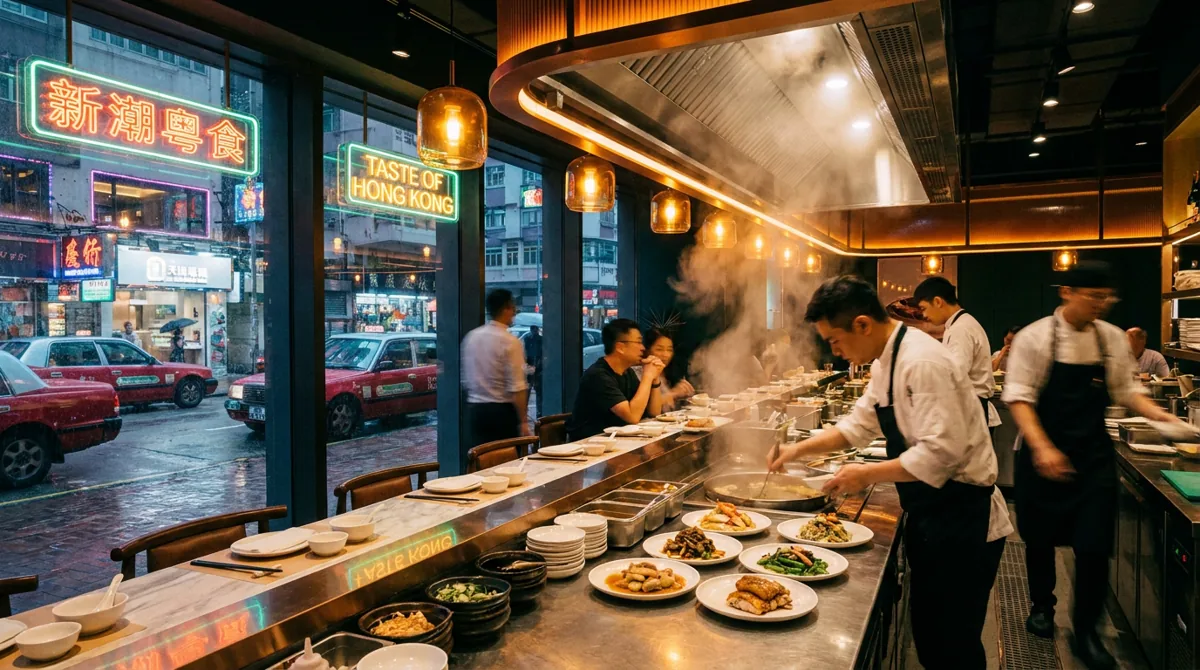
You have eaten in a cha chaan teng a thousand times. You have probably never once looked at it. The melamine plates, the cryptic codes a waiter scrawls on a pad, the milk tea engineered to an exact formula — Hong Kong's diners are so ordinary that they have become invisible. The Cha Chaan Teng Codex, a sharp new exhibition at Airside's Gate33 Gallery in Kai Tak, exists to make you look again. And here is the catch: it closes on 31 July 2026.
In This Guide
Why this exhibition matters
Ask anyone what they love about Hong Kong and a cha chaan teng will be near the top of the list — the value, the speed, the 2am bowl of instant noodles that somehow tastes better than it should. Yet we almost never stop to examine the thing itself. That blind spot is exactly the point of The Cha Chaan Teng Codex.
The show is curated by architectural historian Charles Lai and product designer Kay Chan Wan Ki, working with a cross-disciplinary team of architects, carpenters, graphic designers, filmmakers and chefs. Their argument is that the humble diner is a masterpiece of unnoticed design — every teacup, booth and hand-painted sign the result of decades of quiet problem-solving. Time Out Hong Kong singled out its preserved neon sign and salvaged café door as highlights.
It also lands at the right address. Gate33 Gallery sits inside Airside, the Nan Fung development built on the old Kai Tak airport runway; the gallery's name nods to Gates 1 to 32 of the former airport. A show about disappearing Hong Kong, staged on the ground where planes once landed, has a neat symmetry to it. For the wider picture, our round-up of the best art exhibitions in Hong Kong this summer shows how crowded the calendar has become.
What's actually inside the seven chapters?
The exhibition unfolds across seven chapters, each tackling a different layer of cha chaan teng culture — from dusty paperwork to the science of a scrambled egg. It is part museum, part stage set, and it rewards a slow walk-through.
The Seven Chapters at a Glance
- Chapter 1 — Artefacts: historic objects, including original 1951 licence applications from Yuk Woo Cafe and the preserved neon sign of Wan Chai's shuttered Sun Fung Kee.
- Chapter 2 — The reconstruction: a vintage diner you enter through the actual sign and door of Sheung Wan's demolished Hoi On Cafe, complete with classic booth seating.
- Chapter 3 — The beverage station: a full-scale recreation of the hyper-organised "nerve centre", plus the evolution of teapots, menus and ceramic teacups.
- Chapter 4 — The science of eggs: a deconstruction of the perfect scramble, with an olfactory installation you can actually smell.
- Chapters 5 to 7 — Contemporary voices: young chefs and chocolatiers reinterpreting the classics, filmmakers on the cha chaan teng as a movie backdrop, and a retail corner of plushies, rugs and novelty chocolate.
The structure is clever because it moves from the factual to the sensory to the playful. You arrive as a curious observer and leave having, in a small way, worked a shift.
Neon, a 1951 licence and a rescued café door
The opening rooms are where the history hits hardest. Chapter one displays genuine artefacts from decades past, among them the original 1951 licence applications from Yuk Woo Cafe and the salvaged, glowing neon sign of Sun Fung Kee, a Wan Chai institution that has since closed.
The emotional gut-punch comes next. To enter the reconstructed diner of chapter two, you pass through the actual sign and door of the former Hoi On Cafe, the much-loved Sheung Wan bing sutt that was demolished. Inside, the booth seating tells its own design story: it emerged from small local furniture makers who adapted Nordic mid-century shapes using whatever regional materials they could get hold of.
That detail is the whole thesis in miniature — Hong Kong design as resourceful, borrowed and quietly brilliant. It is the same instinct that produced the city's silky Hong Kong-style milk tea and the East-meets-West menus you still see today.
Can you keep up with a cha chaan teng waiter?
This is not a show of static glass cases. Its best trick is putting you to work. In one interactive station you step into the shoes of a waiter: first you memorise the cryptic shorthand scrawled on the wall — the codes that turn "iced lemon tea" or "coffee-tea mix" into two-character flicks of a pen — and then the phone rings.
Pick it up, listen, and jot down the order using the jargon you have just learned, as fast and as accurately as you can. It is harder than it looks, and it gives you a flash of respect for the aunties and uncles who do it without breaking stride.
Chapter four turns scientific, deconstructing the egg dishes these places are famous for, then hands you an olfactory installation: lean in and smell soy-sauce chicken leg, curry beef brisket and Hong Kong-style milk tea, piped out on demand. It is the kind of detail that makes you hungry for the real thing — our guide to the city's best dai pai dong is a fine next stop.
From bing sutt to your local: a short history
To understand the cha chaan teng, you have to start with the bing sutt (冰室), literally "ice room". These 1950s cafés served Western-style light refreshments — sandwiches, pastries, cold drinks — to a city discovering refrigeration. As menus expanded into hot meals and rice dishes, the fuller-service cha chaan teng (茶餐廳) was born.
The exhibition is full of these origin stories. One that delighted its curators, as the South China Morning Post reported: the cheap, durable melamine tableware that defined the diners of the 1970s turned out to be stamped "Made in Hong Kong" — proof that the city's manufacturing boom literally set the table. It is a reminder that a cha chaan teng is a time capsule of local industry, not just lunch.
For the living, breathing version once you have done the history, our pick of the best cha chaan tengs in Hong Kong points you to the booths still doing it right.
Dates, tickets & opening hours
The practical news is good: this is one of the cheapest cultural outings in town. Admission is just HK$20, and children aged three and under go free. The show was free to enter until 31 March 2026, so the small ticket now applies — but it closes for good on 31 July 2026, so there is a real deadline to beat.
The Cha Chaan Teng Codex — Visitor Essentials
Gate33 Gallery generally opens Monday to Thursday from noon to 8pm, and Friday to Sunday from 11am to 9pm. Hours can change around events, so confirm on the official Airside listing before you travel.
How do you get to Airside?
This is the easy part. Airside is built directly on top of the MTR, so take the Tuen Ma Line to Kai Tak Station and leave via Exit C, which feeds straight into the mall — then ride up to the third floor for Gate33 Gallery. From Kowloon East or Hung Hom you are only a few minutes away by train.
Driving? There is paid parking in the Airside car park off Concorde Road, plus EV charging and bicycle slots. Because the gallery sits inside a full shopping centre, it is genuinely all-weather — a useful card to have up your sleeve during our typhoon-prone summer, when an indoor plan can save the day. Pair it with our list of indoor things to do in Hong Kong and you have a complete rainy-day itinerary.
Is it worth the trip?
Yes — and not only for the nostalgia crowd. The Cha Chaan Teng Codex is smart without being dry, hands-on without being gimmicky, and it gives you a new lens on a place you thought you knew. At HK$20 for a couple of hours, it is one of the best-value culture tickets in the city right now.
It also sits beautifully alongside the season's bigger design shows; if you have already seen Design Ah! at M+, this is the local, edible companion piece. Go on a weekday if you can, leave time for the smelling station, and do not skip the gift shop — where else can you buy a pineapple-bun plushie or cha chaan teng-flavoured chocolate?
Before You Go
The show closes on 31 July 2026 — there is no extension announced, so do not leave it. Admission is now HK$20 (it was free only until 31 March), and opening hours can shift around mall events, so check the official Airside listing for the day you plan to visit. As ever in a Hong Kong summer, keep an eye on the weather: a black rainstorm or Typhoon Signal No. 8 can affect mall and transport access.
Frequently Asked Questions
Catch It Before 31 July
The Cha Chaan Teng Codex is a cheap, clever afternoon in Kai Tak — and then it is gone. Plan your visit, then let YumChaNow keep you ahead of the next big show in town.