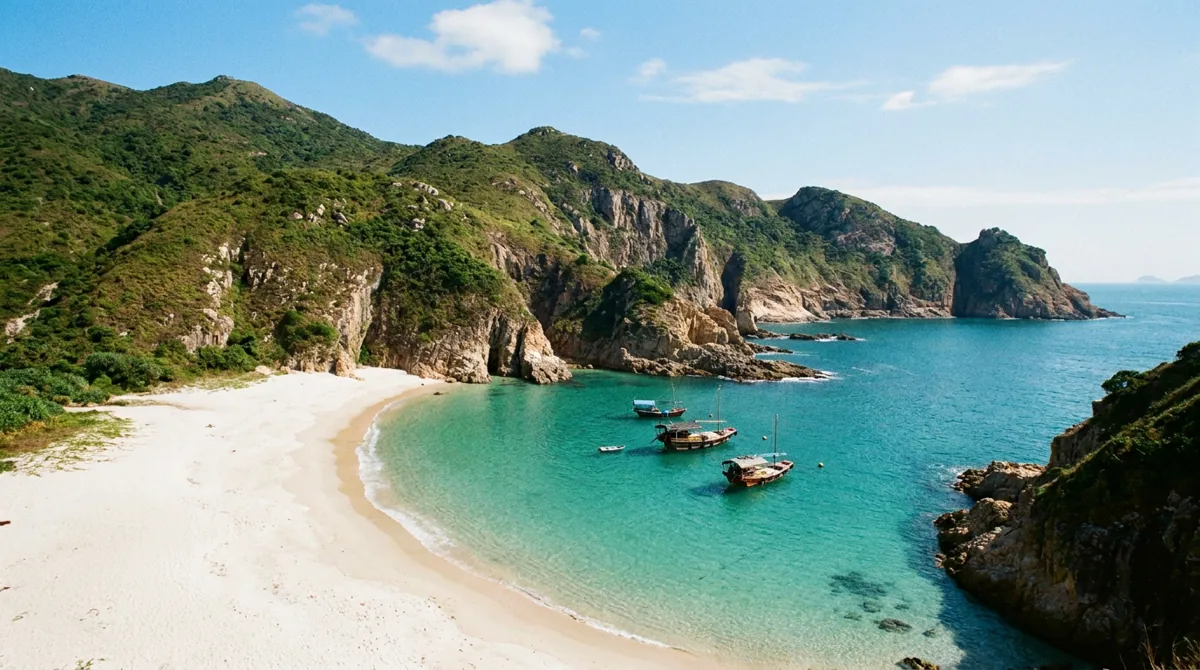
Illustration: Yum Cha Now, AI-generated. It sets the scene and is not a photograph of the venue.
Here is something most visitors never quite believe: one of Asia's most light-drenched cities hides some genuinely brilliant dark skies, and the best of them sit barely an hour from Central. You do not need a telescope or a tour. With a clear, moonless night and a short trip out east, the best stargazing spots in Hong Kong hand you the Milky Way, shooting stars and a sky full of constellations the neon usually hides.
In This Guide
- Where can you actually see the stars in Hong Kong?
- When is the best time to stargaze in Hong Kong in 2026?
- Astropark, Sai Kung: the purpose-built one
- Tai Hang Tun: the easy-access favourite
- Lamma Island: the low-effort escape
- Cheung Sha Beach: stargazing by the sea
- Tai Mo Shan: above the haze
- Cape D'Aguilar: the Island's dark corner
- At a glance: the spots compared
- Which stargazing spot is right for you?
- FAQ
Where can you actually see the stars in Hong Kong?
The honest answer: not from your rooftop in Mong Kok. Hong Kong's urban core is one of the most light-polluted places on Earth, and the orange glow of the city drowns all but the brightest stars. The trick is distance: every kilometre you put between yourself and the high-rises, the more the sky opens up.
That points you in three directions: the country parks and reservoirs of Sai Kung in the east, the southern beaches of the outlying islands, and the high ground of Tai Mo Shan in the New Territories. These are the corners where the Milky Way reappears and a meteor shower is worth the trip. Most are country-park or coastal sites, so pair your evening with one of the city's best outdoor activities and you have a full day out.
One more reason to look up: stargazing is gloriously free. It belongs on any list of free things to do in Hong Kong, costing you nothing but a bus fare and a late night. Here is where to point yourself, and exactly when.
When is the best time to stargaze in Hong Kong in 2026?
Two things make or break a night under the stars: the moon and the weather. Aim for a night close to the new moon, when there is no lunar glare to wash out faint stars, and always check the forecast: Hong Kong's humid, hazy, typhoon-prone summer can cloud over fast. The Hong Kong Observatory's astronomy portal publishes moon phases and observing conditions, and it is the first thing to check before you set out.
Summer is prime time. On warm, clear June-to-August nights the bright core of the Milky Way rides low across the southern sky: the best naked-eye view of our galaxy all year, provided you are somewhere properly dark. Summer also brings the year's friendliest meteor showers.
The headline event of 2026 is the Perseid meteor shower, which peaks overnight on 12–13 August. The timing could not be better: the moon is new on 12 August, so the sky stays inky dark, and a properly dark site can deliver dozens of meteors an hour at the peak. Mark it in your calendar now. The Southern Delta Aquariids are also active from mid-July to late August, peaking around 30 July, though a near-full moon washes out most of this year's peak: manage your expectations and treat any you catch as a bonus.
| 2026 summer sky event | When | Worth it? |
|---|---|---|
| Milky Way core season | June–August, moonless nights | Yes: go dark |
| Southern Delta Aquariids (peak) | ~30 July | Mooned out in 2026 |
| Perseids (peak) | Overnight 12–13 August | The big one: new moon |
Meteor dates per EarthSky; always confirm moon phase and local conditions on the Hong Kong Observatory before you travel.
1. Astropark, Sai Kung: the purpose-built one
If Hong Kong has a stargazing headquarters, this is it. The Astropark (天文公園) sits beside High Island Reservoir in Sai Kung, deep inside Sai Kung East Country Park, and it was built by the Hong Kong Space Museum specifically for looking up. You will find sundials and ancient-style astronomical instruments, concrete telescope piers with power points, and four mounted binoculars you can use free of charge between 7:30pm and 5:30am. Far from any town and with no street lights nearby, it is about as dark as an easily named spot in Hong Kong gets.
The catch is access. Private cars cannot pass the Pak Tam Chung barrier, so the realistic plan is public transport to Pak Tam Chung (北潭涌) and then a New Territories taxi for the final stretch: about HK$60 and 15 minutes, or roughly HK$130 from Sai Kung town centre. It is a mission, but on a clear moonless night it rewards you. For the truly committed, the nearby High Island Reservoir East Dam (萬宜水庫東壩), with its dramatic hexagonal rock columns, is darker still.
Astropark, High Island Reservoir
Facilities and full transport detail on the official Hong Kong Space Museum Astropark page.
2. Tai Hang Tun: the easy-access favourite
For dark skies without the expedition, Tai Hang Tun (大坑墩) in Clearwater Bay Country Park is the sweet spot, and it is the one the Hong Kong Tourism Board itself recommends. By day it is a breezy kite-flying lawn on a gentle slope above the sea; after dark it fills with tripods and astrophotographers. Crucially for a night out, it has real facilities right beside the grass: a public car park, a refreshment kiosk, a toilet and a Chinese-style pavilion to shelter under.
Getting there is refreshingly simple. From MTR Tseung Kwan O station, hop on green minibus 103 (or 103M) to Tai Au Mun (大坳門), then walk 15 to 20 minutes up the road. The 103M runs until about 1:45am, which is unusually civilised for a country-park site, though if you stay out past the last one, you will be calling a taxi. Bring a mat or a folding chair; camping is not allowed here.
Tai Hang Tun
More on the route and the park at the Hong Kong Tourism Board.
3. Lamma Island: the low-effort escape
If a Sai Kung taxi mission sounds like too much, Lamma Island (南丫島) is the gentlest dark-sky escape going. The ferry from Central Pier 4 to Yung Shue Wan (榕樹灣) takes only 20 to 30 minutes, and once you walk away from the village's restaurants and their lights, south along the family trail towards the quieter beaches such as Lo So Shing, the sky deepens noticeably. It is a favourite for an easy, no-fuss evening that still ends with stars overhead. Lamma is one of Hong Kong's best islands by day, too, so come early and make a trip of it.
The one thing to plan around is the ferry. Sailings thin out late in the evening, so check the last boat back before you settle in, or build the night around staying over.
Lamma Island
Confirm current sailings and fares with HKKF before you go.
4. Cheung Sha Beach: stargazing by the sea
On the south coast of Lantau, Cheung Sha Beach (長沙泳灘), Hong Kong's longest stretch of sand, gives you something rare: a wide, unobstructed western horizon over the open South China Sea, with no mountains in the way. That makes it superb for watching the sun drop and the stars come up in one sitting. Lay a towel on the sand, let your eyes adjust, and the lights of the city feel a world away.
Reach it from MTR Tung Chung (Exit B) on bus 11, 11A or 23, or take the ferry to Mui Wo (梅窩) from Central Pier 6 and pick up bus 1, 2 or 4. As with all of south Lantau, the last buses run early, so check return times carefully and carry a torch for the walk back to the stop.
Cheung Sha Beach
Tide and beach information via the Hong Kong Tourism Board.
5. Tai Mo Shan: above the haze
For the clearest skies of all, go up. Tai Mo Shan (大帽山), Hong Kong's highest peak at 957 metres, lifts you above much of the low-level haze and humidity that blur the view from sea level, and on a good night the difference is striking. It is a long-time favourite for sunrise, sunset and night-sky photography.
From MTR Tsuen Wan (Exit A), take bus 51 along Route Twisk and alight at the Country Park stop, then follow Tai Mo Shan Road uphill to the open viewing areas. Two warnings. First, the summit itself houses a weather-radar station and is off-limits. You stargaze from the road and car-park areas below it. Second, it is genuinely cold and windy up top, even in summer, so bring a warm layer. There is no late public transport, so plan a taxi for the way down. Treat it as one of the city's best hikes with a celestial payoff.
Tai Mo Shan
Check conditions and visibility on the Hong Kong Observatory before heading up.
6. Cape D'Aguilar: the Island's dark corner
Most of Hong Kong Island is hopeless for stars, with one notable exception. Cape D'Aguilar (鶴咀), the rugged headland south of Shek O, is the darkest reasonably reachable corner of the Island, with coastal cliffs that turn their back on the city glow. It is also home to Hong Kong's first marine reserve, so it comes with responsibilities: stay on the public road and coast, take every scrap of litter home, and keep your torch low.
From MTR Shau Kei Wan (Exit A3), take bus 9 towards Shek O and get off at the Cape D'Aguilar Road stop on Shek O Road, then walk in along the paved road: roughly 30 to 45 minutes to the cape. There are no facilities and no late transport, so go prepared and self-sufficient. For a softer Island alternative, the quiet sands featured in our guide to secret beaches near Hong Kong work nicely on a calm, dark night too.
Cape D'Aguilar
It is remote and unlit: go in a group, carry a torch and tell someone your plans.
At a glance: Hong Kong's best stargazing spots compared
| Spot | Region & access | Best for | Facilities |
|---|---|---|---|
| Astropark (天文公園) | Sai Kung · Pak Tam Chung + taxi | Serious stargazers | Piers, free binoculars |
| Tai Hang Tun (大坑墩) | Sai Kung · TKO + minibus 103 | Easy access, first-timers | Car park, kiosk, toilet |
| Lamma Island (南丫島) | Islands · ferry from Central | Lowest-effort escape | Village nearby |
| Cheung Sha (長沙) | Lantau · Tung Chung + bus | Beach & sea horizon | Beach facilities |
| Tai Mo Shan (大帽山) | NT · Tsuen Wan + bus 51 | Clearest, highest skies | None up top |
| Cape D'Aguilar (鶴咀) | HK Island · Shau Kei Wan + bus 9 | Island-siders | None |
Every spot here is free. MTR exits, bus numbers and walk times are a guide: confirm the latest routes and last-service times, and always check the weather, before you travel.
Which stargazing spot is right for you?
Six spots, six different nights out. Here is the quick steer.
Pick by what kind of night you want
- You're serious about it: Astropark, telescope piers, free binoculars and proper darkness.
- You want it easy: Tai Hang Tun, a car park, a kiosk and a late minibus home.
- Least effort from town: Lamma Island, a half-hour ferry and a short walk.
- A beach evening: Cheung Sha, sunset and stars over the open sea.
- The clearest sky: Tai Mo Shan, high above the haze (pack a jacket).
- You're stuck on the Island: Cape D'Aguilar, the dark headland past Shek O.
Before You Go
Stargazing in Hong Kong lives and dies by the weather, so always check the Hong Kong Observatory first: summer brings haze, thunderstorms and typhoons that can close in quickly, and outdoor plans should be dropped the moment a storm threatens. Go on a moonless night for the darkest sky, and bring a red-light torch so you can see the path without ruining your night vision. Many of these sites are remote with early last buses, minibuses or ferries, so plan your way home (and a taxi backup) in advance. Dress warmly on Tai Mo Shan, carry water and insect repellent, respect country-park and marine-reserve rules, and take all your litter home. MTR exits and walk times here are a guide, not gospel.
A clear night under the stars is one of the cheapest, most memorable things you can do in this city, and it slots neatly alongside the rest of a weekend outdoors. Plan a daytime walk from our pick of the best outdoor activities in Hong Kong, hop between the outlying islands, or build a whole itinerary from the best free things to do in Hong Kong. The sky does the rest.
Frequently Asked Questions
Chase the Dark
Pick a moonless night, pack a red torch and head east. Then let YumChaNow keep you ahead of Hong Kong's best outdoor nights, hikes and things to do.