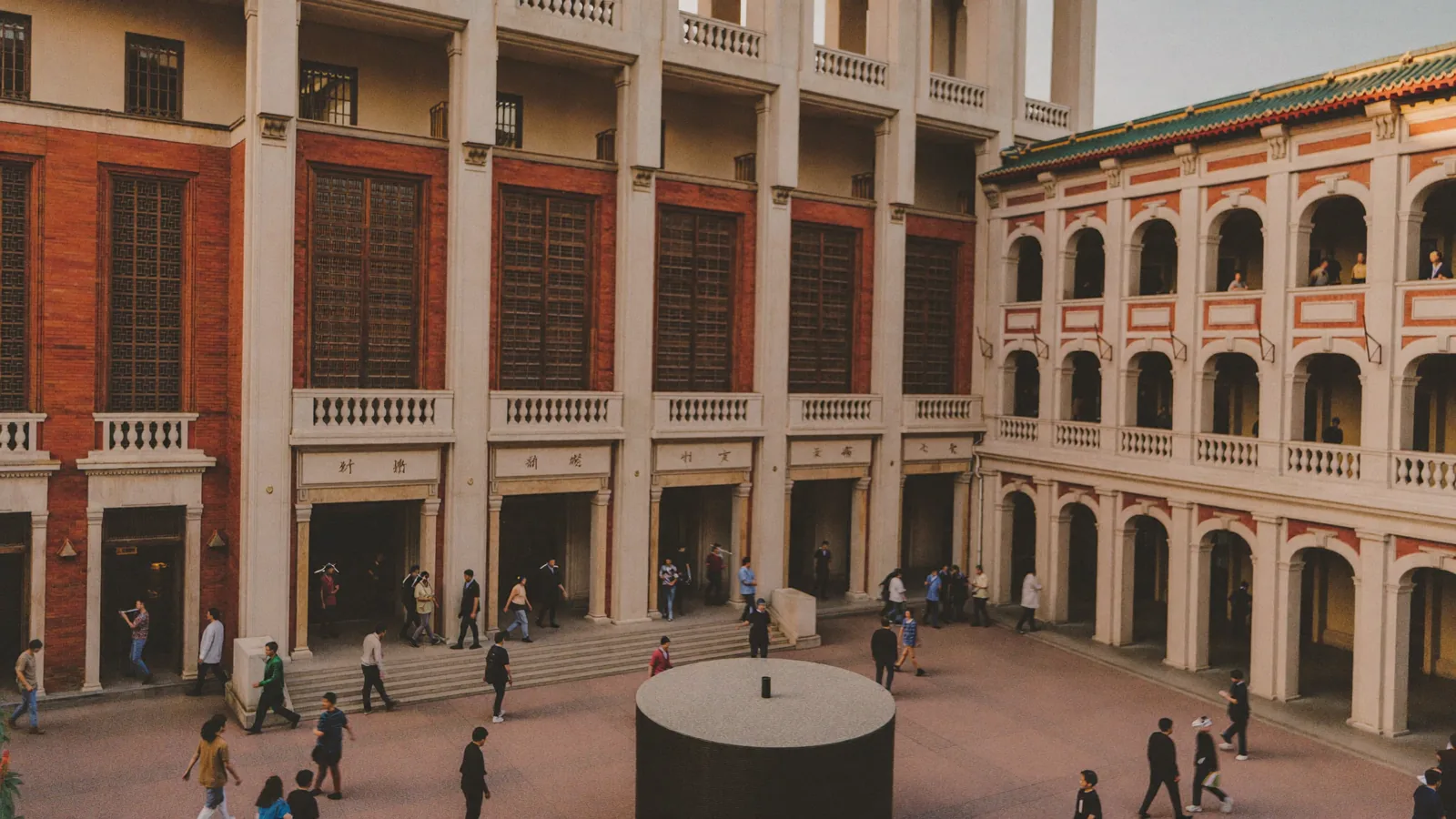
Most exhibitions are finished before you arrive. Open the Box 2026 at Tai Kwun (大館) is not: the whole point is that the artwork is unfinished, and you are one of the people expected to finish it.
It closes on 2 August 2026. If you want to be in it rather than merely look at it, you have about a fortnight.
In This Guide
What Open the Box actually is
Open the Box is Tai Kwun's annual attempt to argue with itself. Tai Kwun Contemporary is a white-cube gallery in a nineteenth-century police compound; Open the Box is the programme where it deliberately stops behaving like one.
Rather than hanging finished objects on white walls, the series hands authorship of the room to the artist and the audience together. It is a durational, spectator-led format — the exhibition on Sunday is not the exhibition that opened on Tuesday, because visitors changed it.
This year's edition, curated by Veronica Wong, is Pleasant Place with Ryan Villamael.
The work: a paper forest that grows
Villamael's material is paper, and the room he has made of it is a suspended canopy of leaves, vines and imagined terrains hanging over the first floor of JC Contemporary.
Visitors move beneath the floating clusters, through what Tai Kwun describes as an immersive, forest-like setting. Then, in the workshops, they cut and assemble fragments of their own and add them to it. Each person's contribution is a private answer to a public question: what does your pleasant place look like?
The accumulation is the artwork. By early August, the canopy hanging over you is the collected imagination of several thousand strangers — which is a more interesting proposition than most things you can look at silently for ten minutes.
Open the Box 2026: Pleasant Place with Ryan Villamael
A visitor-built canopy of paper leaves and vines, growing through the summer inside Tai Kwun's contemporary art building.
Who is Ryan Villamael?
Ryan Villamael (b. 1987, Laguna, the Philippines; lives and works in Los Baños) has spent more than a decade making paper do things paper should not do — intricate cut sculptures and room-scale installations that draw on the Philippine tradition of papercutting.
His subject is rarely the paper itself. It is history, migration and collective memory: how places accumulate overlapping stories, and how maps and landscapes carry politics inside them. Pleasant Place belongs to his ongoing Locus Amoenus series — the Latin term for an idyllic, pastoral haven, a literary device for imagining refuge.
The credentials are real: the Ateneo Art Award in 2015 for Isles, the Cultural Center of the Philippines Thirteen Artists Award in 2021, and exhibitions at the Singapore Biennale, Palais de Tokyo in Paris, Haus der Kulturen der Welt in Berlin, and Para Site here in Hong Kong.
Two ways in: free viewing vs HK$90 sessions
This is the part people get wrong, so here it is plainly. There are two different things happening in the same room.
Free public viewing
4 July – 2 August, Tuesday to Sunday, 11am to 7pm. You walk in, you walk under the canopy, you leave. No charge. Closed Mondays.
Co-creation sessions (ticketed)
HK$90, which covers one material pack and entry for one person. Sessions run Tuesday to Friday, 1pm to 7pm, and Saturday to Sunday, 11am to 7pm, with each activity timeslot lasting 90 minutes. Tickets are sold through the Tai Kwun website and art-mate, and Tai Kwun asks you to register and pay in advance online. Daily quotas are limited and first-come, first-served.
Open the Box 2026 at a glance
| Detail | What to know |
|---|---|
| What | Open the Box 2026: Pleasant Place with Ryan Villamael |
| When | 4 July – 2 August 2026, closed Mondays |
| Where | 1/F, JC Contemporary, Tai Kwun, 10 Hollywood Road, Central |
| Free viewing | Tue–Sun, 11am–7pm |
| Co-creation | HK$90 incl. material pack; Tue–Fri 1–7pm, Sat–Sun 11am–7pm; 90 min |
| Closing ceremony | 2 August, 4–7pm, free admission (participants get priority access) |
| Best for | Families, anyone bored of looking at art from behind a rope |
Getting there
Tai Kwun is at 10 Hollywood Road, Central. Tai Kwun's own visitor information lists two MTR routes: Central station, Exit D1 (Wheelock House), and Hong Kong station, Exit E (One IFC). Both leave you with an uphill walk — this is Central, and the hill is not optional.
The compound itself is open 8am to 11pm, but JC Contemporary keeps gallery hours: 11am to 7pm, Tuesday to Sunday. Plan around the gallery, not the gates.
Is it worth the HK$90?
If you want to see the work, no — the free viewing exists and it is genuinely free. Walk in, look up, leave.
If you have children, or if you have ever felt that Hong Kong's art institutions ask you to be a spectator rather than a participant, then HK$90 for 90 minutes and a material pack is one of the better value propositions in Central. You are not buying a ticket; you are buying a small permanent stake in what everyone else sees for the next fortnight.
The closing ceremony on 2 August, 4–7pm, is free — and participants get priority access, which is a quiet incentive to book a session rather than just turn up at the end.
For the wider picture, our guide to Hong Kong's summer exhibitions covers what else is on, and the best art galleries in Hong Kong maps the rest of the scene. If you are making a day of the compound, our Tai Kwun guide covers the bars, the heritage blocks and where to eat.
Open the Box 2026: your questions answered
The verdict
Hong Kong summers are for indoor art, and most of it asks nothing of you. This one hands you a material pack and a pair of scissors and asks what refuge looks like.
It comes down on 2 August. Go before then, and go on a day that isn't Monday.
See More in Hong Kong
Exhibitions, openings and the shows that actually merit the trip. Subscribe to the weekly YumChaNow guide and never miss a closing date again.