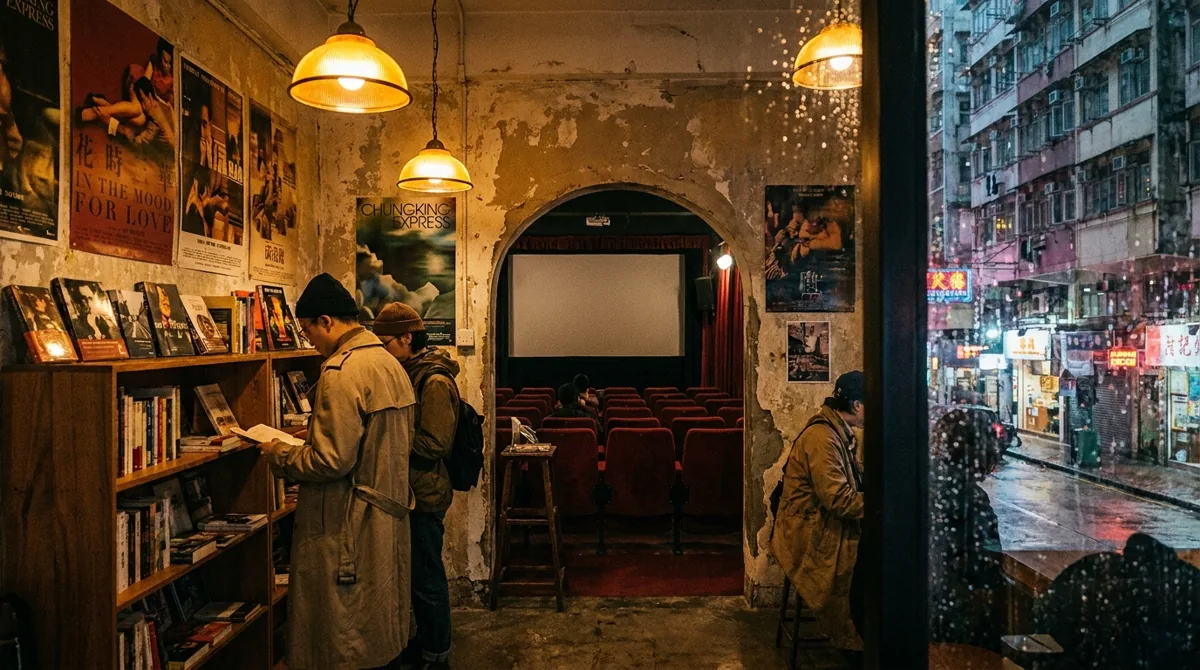
Illustration: Yum Cha Now, AI-generated. It sets the scene and is not a photograph of the venue.
The 50th Hong Kong International Film Festival was, in most measurable ways, a remarkable achievement. Two hundred and fifteen films from seventy-one countries, over twelve days, in venues distributed across a city that takes cinema with unusual seriousness. The opening night, Anthony Chen's "We Are All Strangers" at the Hong Kong Cultural Centre, sold out in minutes. The closing night, Yung Keung's Cyclone, drew queues around the block at Broadway Cinematheque. In between, anyone willing to do the scheduling mathematics could construct a festival experience that covered contemporary Chinese cinema, Japanese genre work, Cannes competition films seeing their Asia premiere, and restored Hong Kong classics from the archive. The difficulty was, as it always is at a festival of this size, that doing the mathematics requires more hours in the day than are generally available.
What Is the Hong Kong International Film Festival?
The Hong Kong International Film Festival is Asia's longest-running and most prestigious film festival — it celebrated its 50th anniversary in 2026. Founded in 1977, HKIFF has, across five decades, served as the primary gateway for Asian cinema to reach international audiences and for international art-house cinema to reach Hong Kong. Its position in the calendar — late March to mid-April — places it just after the Berlin International Film Festival and ahead of Cannes, meaning it regularly presents significant competition and art-house titles before most of the world has seen them.
What distinguishes HKIFF from comparable festivals in Busan, Tokyo, or Singapore is its particular curatorial intelligence around Chinese-language cinema: it functions as the definitive showcase for Hong Kong cinema, Taiwanese cinema, and mainland Chinese independent film, while also maintaining genuinely world-class programming across European, American, and Southeast Asian work. In a film culture that has historically fragmented along national and language lines, HKIFF is one of the few places where all those traditions are presented with equal seriousness.
HKIFF50: The 50th Anniversary Edition
The 50th edition carried the theme "50 and Beyond: Framing the Future", a celebration of five decades of cinematic exchange that simultaneously redirected attention toward what Asian and global cinema might become. The anniversary programming included a curated retrospective strand of films that had shaped HKIFF's history: key Hong Kong New Wave titles, landmark Asian films that had received their first significant international exposure at HKIFF, and a selection of films from the inaugural 1977 programme.
The 2026 edition included 215 films from 71 countries: a programme scope that requires genuine selectivity from the visitor. Eleven world premieres and 49 Asian premieres meant the festival was genuinely launching films into public consciousness, not simply presenting known quantities from other festivals. For a city of Hong Kong's size, this is a remarkable curatorial footprint.
HKIFF 2026 (HKIFF50): Key Facts
How to Buy Tickets
All HKIFF tickets are sold through hkiff.org.hk. The booking system opens in phases: HKIFF Members and supporters receive early access, typically two weeks before general public sales. Given that opening night and high-profile world premieres can sell out within minutes of general public booking opening, HKIFF membership is worth purchasing if you plan to attend more than three films: the modest annual membership fee is justified purely by the early booking access.
Single-screening tickets are available for individual films. Multi-film passes are also available and offer moderate discounts for committed festival-goers. Tickets for restored classics and retrospective screenings tend to have more availability than those for world premiere or high-profile competition slots.
Ticket Buying Strategy
| If You're... | Recommendation |
|---|---|
| Attending 1–2 films | General public single tickets; book on opening day of public sales |
| Attending 3–5 films | Consider HKIFF membership for early access; choose films across different venues and days |
| Attending 6+ films | HKIFF membership essential; build schedule early from programme PDF before online booking opens |
| Targeting world premieres | HKIFF membership only viable route; world premiere slots are limited and sell fast |
| Flexible / last-minute | Check hkiff.org.hk daily for returns; some screenings release tickets in the 48h before showtime |
Key Venues
HKIFF is distributed across multiple venues across Hong Kong Island, Kowloon, and occasionally New Territories. The logistics of venue-hopping are manageable but require planning: a screening at Broadway Cinematheque (Yau Ma Tei, Kowloon) and a subsequent screening at the Hong Kong Cultural Centre (TST) are walkable, but a Sheung Wan to Sai Wan Ho double-header requires timing the MTR carefully.
HKIFF 2026 Venues Guide
| Venue | Location | MTR | Character |
|---|---|---|---|
| Hong Kong Cultural Centre | 10 Salisbury Rd, TST | Tsim Sha Tsui (Exit E) | Main prestige screenings; opening/closing night gala |
| Broadway Cinematheque | 3 Public Square St, Yau Ma Tei | Yau Ma Tei (Exit C) | Art-house heart of HKIFF; most independent films |
| MCL Cinema Telford | Kowloon Bay | Kowloon Bay | Mainstream and crowd-pleasing premieres |
| The Grand Cinema | Elements Mall, West Kowloon | Kowloon (ICC) | Premium format screenings |
| Golden Scene Cinema | Kennedy Town | Kennedy Town | Boutique; strong retrospective programming |
Programme Categories to Know
World Cinema
The backbone of HKIFF's international programme: competition and non-competition titles from Europe, the Americas, the Middle East, and Africa. This is where the Cannes, Berlin, and Venice competition titles appear in their Asia-Pacific premieres. The curatorial quality is consistently high; the World Cinema strand is where you should look for films that will define the year's conversation about cinema.
Asian Cinema
HKIFF's most distinctive strand: new work from Japan, Korea, Taiwan, mainland China, Southeast Asia, and Central Asia. This is the strand where the festival's curatorial authority is most evident. Films here are often seeing their international premiere; some will go on to major festival prizes in subsequent years. This is where HKIFF does its most important work.
Hong Kong Cinema
New Hong Kong films, restored classics, and retrospective screenings constitute a significant portion of the programme. The restored classics strand, supervised by the HKIFF Association's preservation arm, is one of the festival's most valuable contributions. In a city where the New Wave cinema of the 1980s is both celebrated and physically fragile, the preservation screenings represent something genuinely irreplaceable.
Special Presentations and Retrospectives
Individual director retrospectives, thematic collections, and curated series. In 2026, the 50th anniversary programming included a curated selection of "50 Films That Shaped HKIFF": an opinionated and excellent historical survey that any serious Hong Kong cinephile should attempt to see as much of as possible.
Standout Films of HKIFF 2026
Opening Film: "We Are All Strangers" (Anthony Chen)
Anthony Chen, the Singaporean director best known for Ilo Ilo (2013) and Drift (2023), returned with a film that received its Asian premiere at HKIFF50's opening night. A quiet, deeply felt meditation on displacement and connection, it set the tone for a festival with genuine emotional ambition. The Cultural Centre sold out in under 10 minutes: unsurprisingly, given Chen's reputation in the region.
Closing Film: Yung's Cyclone
The closing night selection at Broadway Cinematheque, a local production that generated significant buzz during the festival, confirmed HKIFF's ongoing commitment to programming Hong Kong work as equal in prestige to international competition titles.
Asian Competition Highlights
The 2026 Asian competition featured exceptional work from Japanese director Ryusuke Hamaguchi's producers' next project, a third film by Korean director Park Chan-wook's long-term cinematographer working on his debut feature, and a Taiwanese family drama that drew comparisons to Hou Hsiao-hsien's familial films of the 1980s.
The Hong Kong Film Awards Connection
The Hong Kong Film Awards (HKFA) are organised separately from HKIFF by the Hong Kong Film Awards Association, but the two events are profoundly interlinked. The HKFA ceremony typically falls in April, often during or immediately after the film festival, making April the peak month for Hong Kong cinema culture in its totality. Films eligible for the HKFA are Hong Kong productions released in the previous calendar year, and many of them screen at HKIFF in retrospective or special presentation slots.
For visitors attending HKIFF, keeping an eye on HKFA nominations gives you a useful filter for Hong Kong productions worth prioritising in the programme. The ceremony itself is worth attending if you can secure tickets. It is the Oscars equivalent for one of the world's most significant national film cultures.
How to Navigate the Programme
The programme PDF (downloadable from hkiff.org.hk before tickets go on sale) is your primary navigation tool. Before booking opens, build a provisional schedule: identify the films you must see (world premieres, directors you follow, restored classics), then fill in around them. The risk of double-booking, two essential films at the same time, is real in a 215-film programme. Build a ranked list per time-slot.
Practical HKIFF Tips
| Topic | Advice |
|---|---|
| Programme PDF | Download and study before public booking opens; essential for building a schedule |
| Subtitles | Most non-English films have English subtitles; always check the programme listing to confirm |
| Returns | Check hkiff.org.hk in the 48h before screenings for returned tickets on sold-out films |
| Travel time | Build 45–60 min between screenings at different venues; don't schedule tight back-to-backs |
| Q&As | Many screenings include post-film Q&As with directors: check the programme; these are among HKIFF's most valuable hours |
| Retrospectives | Less competitive for tickets; often the most rewarding screenings of the festival |
Frequently Asked Questions
More Hong Kong culture guides
See our complete guides to Best Art Galleries in Hong Kong 2026 and Best Theatre in Hong Kong 2026.