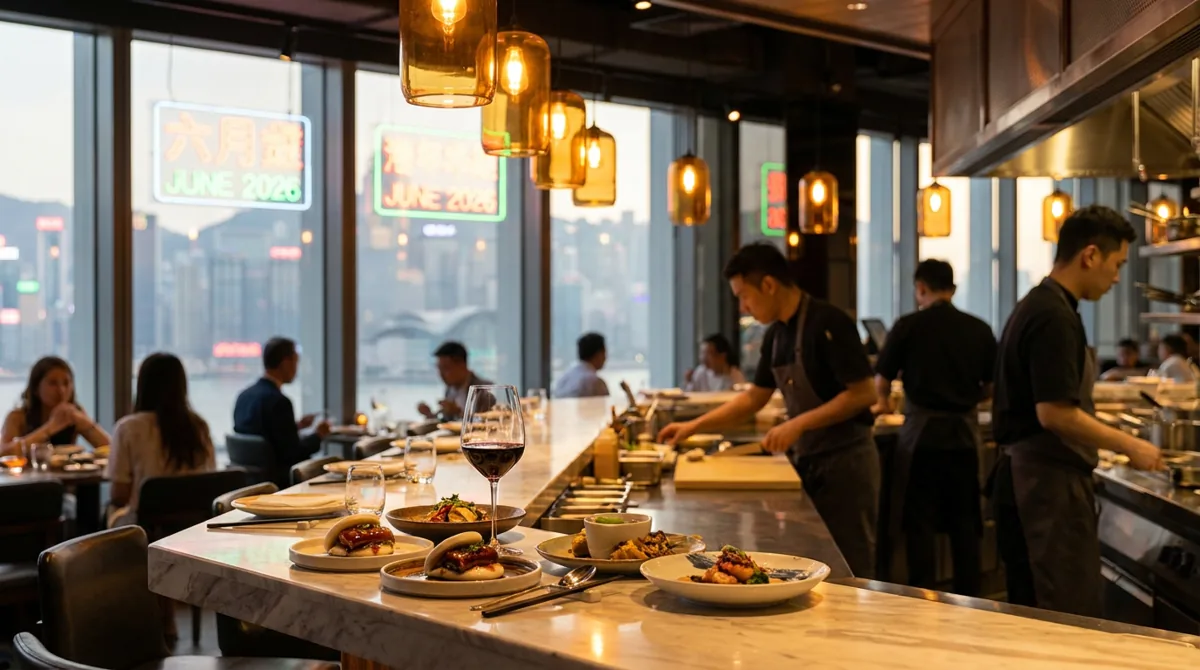
Illustration: Yum Cha Now, AI-generated. It sets the scene and is not a photograph of the venue.
Hong Kong's relationship with the Michelin guide has always been about more than stars. The best Cantonese kitchens here were setting a standard long before the inspectors arrived: the har gao held up to the light so the skin can be examined, the way a tailor examines fabric. The stars recognise that standard; they did not create it. What follows is a guide to the kitchens that honour it.
Hong Kong is home to seven three-Michelin-star restaurants in 2026, and a total of 219 Michelin-recognised establishments across the territory. This is one of the world's great concentrations of starred dining: more intense per capita than Paris, per capita more than Tokyo. Here is my guide to the ones that matter most, and why.
In This Guide
The Seven Three-Star Restaurants
Three Michelin stars represent "exceptional cuisine, worth a special journey." In Hong Kong's case, most of these restaurants are worth a long journey indeed.
Amber 安柏
Chef Richard Ekkebus leads a kitchen that has done something genuinely extraordinary: built a three-star restaurant around a gluten-free and dairy-free menu without any sense of restriction or compromise. The food is ingredient-led modern French, sourced with obsessive care, and the sustainability credentials (Green Star) are hard-earned rather than marketing-led. The room (warm woods, soft lighting, a view over the Landmark atrium) is one of Hong Kong's most beautiful. Amber is the restaurant I recommend when someone asks for the single best meal available in this city.
T'ang Court 唐閣
T'ang Court is Hong Kong's finest Cantonese fine dining room and the most important local cuisine entry on the three-star list. The kitchen is rooted in classical Cantonese techniques: braised abalone of extraordinary quality, whole live seafood prepared with precision, meticulous dim sum at lunch service. This is not a restaurant trying to innovate or reinterpret. It is a restaurant attempting, and succeeding, at the highest possible execution of its tradition. This is the kitchen to measure every other har gao against.
Ta Vie 旅
Chef Hideaki Sato's Ta Vie is the most intellectually interesting restaurant on the three-star list. The cuisine is a fusion of French technique and Japanese sensibility, but fusion executed at a level where the two traditions genuinely illuminate each other rather than compromise. The small dining room at The Pottinger hotel creates an intimate setting; the tasting menus are precise, seasonal, and beautifully detailed. Ta Vie rewards a diner who wants to think as well as eat.
Forum 富臨飯店
Forum is one of Hong Kong's most famous restaurants for a specific reason: the abalone. Chef Yeung Koon Yat — known as the "Abalone King" — has spent decades refining the preparation of braised whole abalone, and Forum's version has defined the standard against which all others are measured in Hong Kong. The restaurant is not flashy; the room has the feel of a serious Hong Kong Cantonese restaurant that has been here for decades and has nothing to prove to anyone. Which it hasn't — and doesn't.
Sushi Shikon 鮨 志魂
Chef Yoshitake Mitsuhiro flies fish from Tsukiji to Hong Kong daily. The counter seats fourteen. The omakase progresses through nigiri assembled with the focused intensity of a master craftsman: rice at ambient temperature, fish at its optimal moment, each piece designed as a complete thought. This is sushi as philosophy. The difficulty of securing a reservation is the only barrier: Sushi Shikon operates a waitlist that measures in months, not weeks.
Essential Two-Star Picks
Hong Kong's 13 two-star restaurants in 2026 represent extraordinary dining at a step below the absolute peak, often equally thrilling, frequently better value. These are the ones I recommend most readily.
Lung King Heen 龍景軒
The first Chinese restaurant in the world to earn three Michelin stars (it now holds two), Lung King Heen remains one of the most technically accomplished Cantonese kitchens in Asia. Chef Chan Yan Tak's dim sum lunch, with Victoria Harbour visible through the fourth-floor windows, is one of the defining Hong Kong dining experiences. The dinner menu, focused on whole fish and roasted meats, is equally superb. Come for dim sum if you can secure a lunch booking.
Ying Jee Club 營致會館
Ying Jee Club occupies a gracious Central dining room and represents the most sophisticated contemporary Cantonese cooking in Hong Kong after the three-star tier. The kitchen takes traditional Cantonese foundations and applies them with modern precision: the results are dishes that feel both deeply familiar and freshly considered. The wonton soup here is a lesson in clarity; the braised dishes are refined without losing their soul. The private dining room for special occasions is exceptional.
Best One-Star Chinese Restaurants
Essential One-Star Chinese Restaurants
| Restaurant | Cuisine | Neighbourhood | Price/person |
|---|---|---|---|
| Duddell's 都爹利會館 | Contemporary Cantonese | Central | HKD 400–600 |
| The Chairman 大班樓 | Classic Cantonese, Seasonal | Central | HKD 500–800 |
| Seventh Son 家全七福 | Traditional Cantonese | Wan Chai | HKD 350–600 |
| Ho Lee Fook 好嚟發 | Chinese BBQ, Contemporary | SoHo, Central | HKD 300–500 |
| Rùn 潤 | Cantonese (Two Stars) | Renaissance Harbour View | HKD 500–800 |
Best One-Star International Restaurants
Essential One-Star International Restaurants
| Restaurant | Cuisine | Neighbourhood | Price/person |
|---|---|---|---|
| New Punjab Club | Punjabi (world's first Michelin-starred) | Central | HKD 400–600 |
| Arbor | European, seasonal (Two Stars) | Central | HKD 1,200–1,800 |
| Épure | Modern French | TST | HKD 800–1,200 |
| Amalfitana | Italian, Campanian | Central | HKD 400–700 |
| Tate Dining Room 泰迪英倫餐廳 | Contemporary French | Sai Ying Pun | HKD 1,000–1,500 |
What Is Bib Gourmand? Best Affordable Value
The Michelin Bib Gourmand designation recognises restaurants offering quality food at a reasonable price: defined in Hong Kong as a complete meal (starter, main, dessert) under HKD 500. There are over 60 Bib Gourmand entries in the 2026 Hong Kong guide, and many of the city's most celebrated affordable institutions are among them.
Essential Bib Gourmand Restaurants
| Restaurant | Specialty | Neighbourhood | Budget |
|---|---|---|---|
| Tim Ho Wan 添好運 | Dim sum (the original starred dim sum chain) | Multiple; orig. Mong Kok | HKD 80–150 |
| Lin Heung Kui 蓮香居 | Traditional dim sum, old-school style | Sheung Wan | HKD 100–200 |
| Liu Yuan Pavilion 柳苑 | Shanghainese cuisine | Causeway Bay | HKD 200–350 |
| Good Hope Noodle 好望角麵家 | Wonton noodles, Cantonese | Mong Kok | HKD 60–100 |
How to Book Michelin Restaurants in Hong Kong
Booking systems and timelines vary significantly. Here are the key methods:
OpenTable: The most widely used platform for Hong Kong Michelin restaurants. Amber, Ta Vie, Ying Jee Club, and many one-star restaurants are on OpenTable. Book slots open weeks or months in advance: set alerts for the restaurants you want.
Direct by Phone or Email: T'ang Court, Forum, and Lung King Heen prefer direct booking. Many Cantonese restaurants maintain their own reservation systems; call during business hours and be prepared to state dietary requirements. Staff at five-star hotel restaurants (Four Seasons, Langham, Mandarin Oriental) are accustomed to international callers.
Michelin's Own Platform: guide.michelin.com has direct booking links for all starred restaurants in Hong Kong.
Concierge Booking: If you're staying in a five-star hotel, the concierge team can often secure reservations at companion hotels' restaurants with more ease than a cold call. The Peninsula's concierge, for example, can often help secure Four Seasons or Mandarin Oriental bookings through industry relationships.
2026 Michelin Stars: Full List at a Glance
Three-Star Restaurants Hong Kong 2026
| Restaurant | Cuisine | Location |
|---|---|---|
| Amber | Modern French (gluten/dairy-free) | Landmark MO, Central |
| Caprice | Classic French | Four Seasons, Central |
| Sushi Shikon | Edomae Sushi | The Mercer, Sheung Wan |
| T'ang Court | Cantonese | Langham Hotel, TST |
| Ta Vie | Contemporary French-Japanese | The Pottinger, Central |
| Forum | Cantonese (abalone specialist) | Wan Chai |
| 8½ Otto e Mezzo Bombana | Modern Italian | Alexandra House, Central |
Two-Star Restaurants Hong Kong 2026 (Selected)
| Restaurant | Cuisine | Location |
|---|---|---|
| Lung King Heen | Cantonese | Four Seasons, Central |
| Tin Lung Heen | Cantonese | Ritz-Carlton ICC, W Kowloon |
| L'Atelier de Joël Robuchon | Modern French | The Landmark, Central |
| Ying Jee Club | Contemporary Cantonese | Central |
| Arbor | European seasonal | H Queen's, Central |
| Rùn | Cantonese | Renaissance Harbour View, Wan Chai |
| Bo Innovation | X-treme Chinese | Wan Chai |
| Tate | Contemporary French | Sai Ying Pun |
| Cristal Room by Anne-Sophie Pic | French (new 2026) | Baccarat Hotel area, Central |
Frequently Asked Questions
Explore More Dining Guides
50 Best Restaurants in Hong Kong · Best Cantonese Restaurants · Best Dim Sum Restaurants