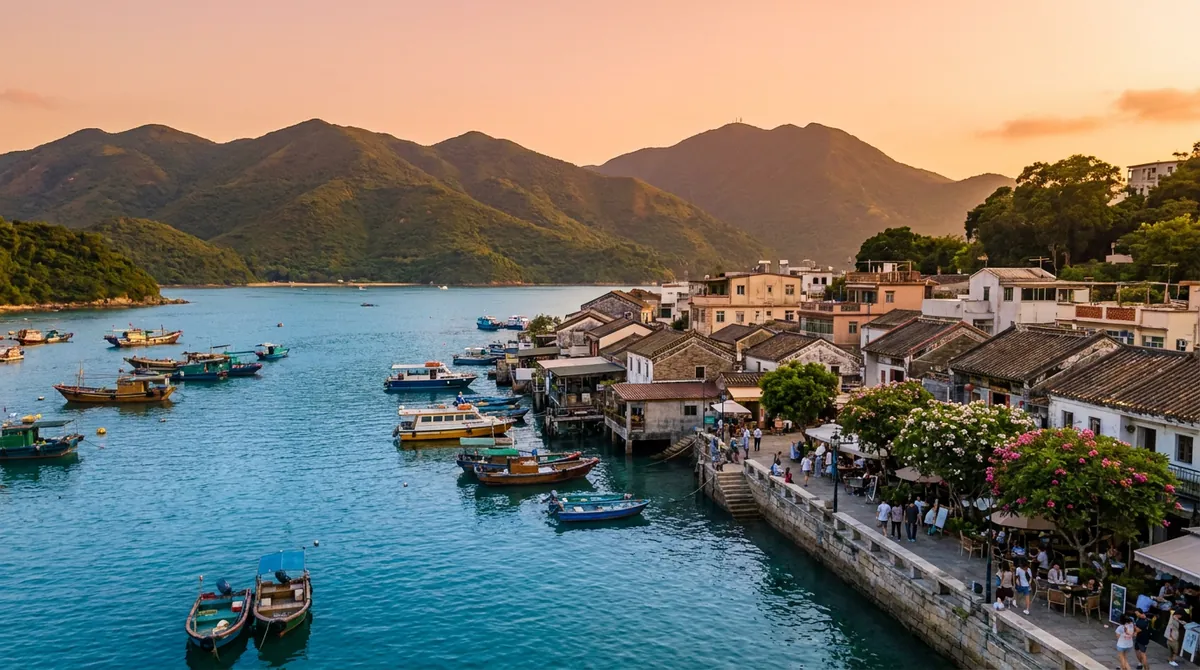
Illustration: Yum Cha Now, AI-generated. It sets the scene and is not a photograph of the venue.
One of Hong Kong's quiet gifts is this: you can leave it so easily. The MTR network stretches to places where the city dissolves into granite and sea grass. Ferries cross to islands where the pace of life runs by tides rather than timetables. High-speed trains carry you into the heart of southern China in under an hour. Each of these journeys returns something that the city, magnificent as it is, slowly takes away: the sensation of space, of distance, of time that belongs to you.
In This Guide
Within Hong Kong: Islands & Country Parks
Sai Kung 西貢
Sai Kung is Hong Kong's most beautiful coastal district: a peninsula of white sand beaches, rocky headlands, and water the colour of deep jade. The town itself is lively: a waterfront promenade of seafood restaurants with live tanks on the pavement and weekend hikers refreshing themselves at the end of long walks. The MacLehose Trail passes through here; the East Dam at High Island Reservoir is one of the most dramatic man-made landscapes in Asia. Take the 792M bus from Diamond Hill, or taxi from Clearwater Bay Road.
Tai O 大澳: Lantau Island
Tai O is the most atmospheric village in Hong Kong: stilt houses over tidal channels, narrow lanes scented with dried seafood, an elderly population that still lives by the rhythms of the fishing trade. The pink dolphins that inhabit the Pearl River estuary can sometimes be seen from the boat trips that depart from the village. Combine Tai O with the cable car from Tung Chung, the Big Buddha at Po Lin Monastery, and a walk through the Wisdom Path for a full Lantau day. Return by the same cable car or direct bus from Tai O to Tung Chung.
Cheung Chau 長洲
Cheung Chau is Hong Kong's most beloved island escape precisely because it has so little in common with Hong Kong. There are no cars: the island is entirely pedestrian and bicycle. The seafood restaurants along the harbour front are among the best-value in the territory. The north beach has calm water suitable for swimming. In spring (late April), the Cheung Chau Bun Festival draws enormous crowds; at other times the island is genuinely peaceful. The ferry is frequent and affordable; no MTR, no taxi, no skyscrapers. This is what recovery feels like.
Pat Sin Leng & Plover Cove 八仙嶺 / 船灣淡水湖
For the walker who wants to disappear properly, Pat Sin Leng (Eight Immortals Ridge) offers a ridge traverse with unbroken views over Plover Cove reservoir on one side and Tolo Harbour on the other. The Plover Cove country park is extraordinarily peaceful for its proximity to a city of seven million: herons stand in the shallows, the water is still, and the hills above are traced with granite. Combine with lunch at Tai Po Market (a 15-minute bus ride away) for a day that genuinely resets the nervous system.
Macau — 60 Minutes by Ferry
Macau 澳門
Macau repays a day trip more than any other destination from Hong Kong. The old city — a UNESCO World Heritage Site of Baroque churches, Portuguese-tiled pavement, and colonial administrative buildings — is compact enough to walk entirely in a morning. The Ruins of St Paul's is the iconic image; the A-Ma Temple at the peninsula's tip is older and more atmospheric. The food is extraordinary: Macanese cuisine — a fusion of Portuguese, Chinese, Malay, and Indian influences — produces dishes available nowhere else on earth. Pasteis de nata from Lord Stow's Bakery on Coloane are essential. The Cotai Strip mega-casinos are a spectacle worth witnessing even if you don't gamble.
Shenzhen 深圳 — 40 Minutes by MTR
Shenzhen 深圳
Shenzhen is the most remarkable urban story of the last 50 years: a fishing village in 1980, a city of 18 million today. It now has more tech unicorns per square kilometre than anywhere outside Silicon Valley and a food and arts scene that is evolving faster than any observer can track. For a day trip: OCT Loft (Overseas Chinese Town) for galleries and creative spaces; the Shenzhen Bay waterfront for the new cultural buildings; and Dongmen for market shopping. The MTR journey via Lo Wu or Lok Ma Chau is straightforward, the crossing simple for most passport holders.
Guangzhou 廣州 — 47 Minutes by High-Speed Rail
Guangzhou 廣州
Guangzhou is the capital of Cantonese culture: the origin of the language, the cuisine, and much of what Hong Kong considers its own. For a food-oriented day trip, there is nowhere better: dim sum at one of the great traditional teahouses, roasted goose from a street counter, the night market in Shangxiajiu pedestrian street. The Shamian Island colonial district and the Canton Tower are interesting architecturally. The Guangzhou Museum of Art and Chen Clan Ancestral Hall are worth your afternoon. Return on the last train; the journey is comfortable and the experience of arriving in Guangzhou at 47 minutes from Hong Kong West Kowloon still impresses me after years of doing it.
Zhuhai 珠海: via HZMB Bridge
Zhuhai 珠海
Zhuhai is the quietest and most relaxed of the Pearl River Delta cities: a coastal city with a genuine seafront promenade (the Lover's Road / 情侣路), high-quality Cantonese seafood, and a pace of life that contrasts pleasingly with Hong Kong. Access via the Hong Kong-Zhuhai-Macau Bridge is now straightforward: take the shuttle bus from HKIA Bus Terminus to Zhuhai Port. Combine with a morning in Macau by taking the ferry to Taipa and then a Macau city bus to the Zhuhai border crossing for maximum Pearl River Delta value in a single day.
Transport Quick Reference
Day Trip Transport Summary — 2026
| Destination | Transport | Journey Time | Cost (Return) | Visa Required? |
|---|---|---|---|---|
| Sai Kung | MTR + Bus 792M | 45–60 min | HKD 20 | No |
| Tai O, Lantau | MTR Tung Chung + Bus 11 | 90 min | HKD 30–35 | No |
| Cheung Chau | Ferry from Central Pier 5 | 40 min | HKD 37–70 | No |
| Macau | Ferry from Sheung Wan / Kowloon | 60 min | HKD 320–400 | No (most passports) |
| Shenzhen | MTR East Rail to Lo Wu | 40 min | HKD 90 | No (up to 15 days) |
| Guangzhou | XRL from West Kowloon | 47 min | HKD 200–260 | No (up to 15 days) |
| Zhuhai | Bridge bus from HKIA | 75–90 min | HKD 90–130 | No (up to 15 days) |
Frequently Asked Questions
More Outdoors & Travel
Read our guide to Best Islands in Hong Kong 2026 and Best Weekend Getaways from Hong Kong 2026.