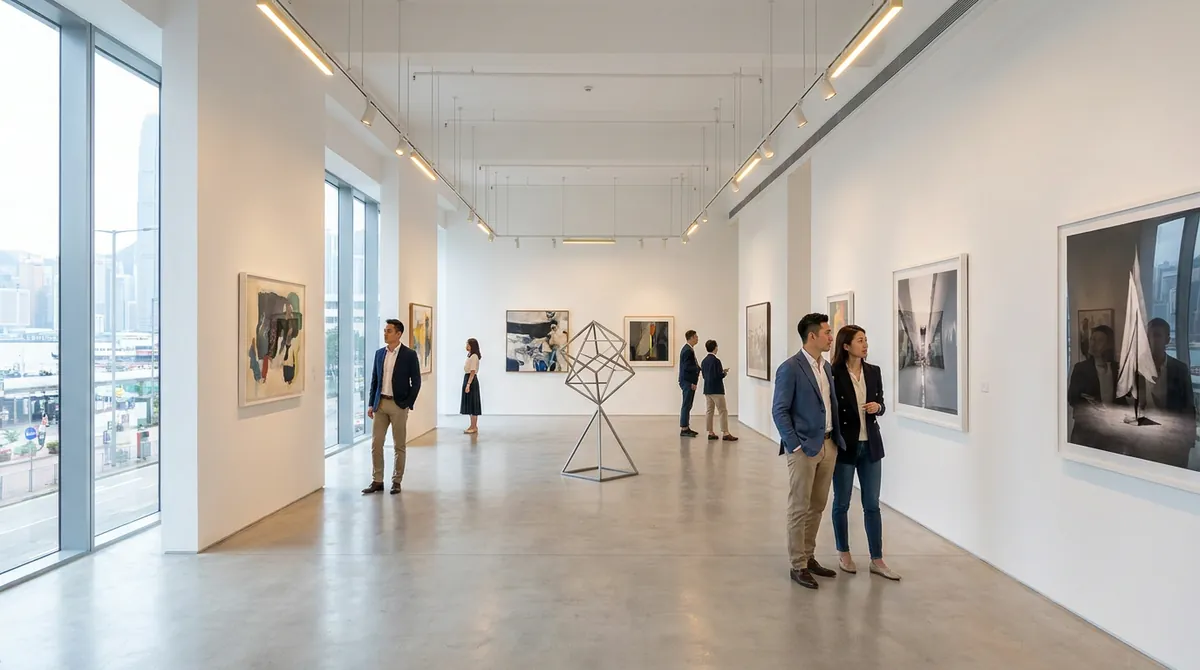
Illustration: Yum Cha Now, AI-generated. It sets the scene and is not a photograph of the venue.
There is a particular quality to the week Art Basel descends on Hong Kong that I find difficult to explain to people who haven't experienced it. The city — already one of the world's most charged urban environments — acquires an additional layer of feverish energy. Gallery openings stretch past midnight in Wong Chuk Hang. Collectors in linen suits queue for dim sum at six in the morning before the fair opens. And in the exhibition halls of the HKCEC, 240 galleries from 41 countries have arranged the most concentrated presentation of contemporary and modern art in Asia under one roof. Art Basel Hong Kong is, by any reasonable measure, one of the most important art events on the global calendar — and in 2026, its 13th edition delivered something genuinely exceptional.
What Is Art Basel Hong Kong?
Art Basel Hong Kong is the Asian edition of the world's premier contemporary art fair, founded in Basel, Switzerland in 1970. The Hong Kong edition launched in 2013 (acquiring what was then known as Art HK) and has grown into Asia's pre-eminent gathering point for the international art market. The fair operates across four programmatic sectors (Galleries, Discoveries, Insights, and the large-scale Encounters) and serves as both a commercial marketplace and a cultural moment for the region.
For context: over a five-day run, Art Basel Hong Kong draws tens of thousands of visitors from across Asia-Pacific, Europe, and the Americas. The galleries represented range from blue-chip global powerhouses (Gagosian, White Cube, Hauser & Wirth) to ambitious regional galleries introducing important Asian artists to an international audience. What distinguishes the Hong Kong edition from Basel and Miami Beach is its particular sensitivity to East Asian art: Korean Dansaekhwa, Japanese Mono-ha, and Chinese ink painting traditions sit alongside Western conceptualism in a dialogue that exists nowhere else in quite the same way.
2026 Edition Highlights
The Echoes Sector: New in 2026
The most significant structural addition to Art Basel Hong Kong 2026 was Echoes, a new sector dedicated entirely to works created within the past five years. Ten curated booths, each featuring works by up to three artists, presented the fair's most pointed statement about contemporary practice. The format (more intimate than the main Galleries sector, less themed than Insights) allowed for careful juxtapositions that rewarded slow looking. This was not a sector you rushed through.
Encounters, Reconfigured
The Encounters sector, dedicated to large-scale installations and site-responsive work, was curated in 2026 for the first time by an Asia-based collective: Mami Kataoka (Director of Mori Art Museum), alongside Isabella Tam, Alia Swastika, and Hirokazu Tokuyama. The result was a more grounded, regionally rooted selection of large-scale work than in previous years: less spectacle, more substance. Works engaged seriously with questions of ecology, memory, and post-colonial geography.
Zero 10: Digital Art Initiative
Following its debut at Art Basel Miami Beach, the Zero 10 initiative for digital-era art made its Asia debut at the Hong Kong edition. For collectors and visitors new to digital and generative work, this was an accessible entry point: the curation prioritised works where digital processes served conceptual ends rather than novelty.
M+ Facade Commission: Shahzia Sikander
One of the week's most memorable experiences happened outside the fair entirely. From March 23, Pakistani-American artist Shahzia Sikander's "3 to 12 Nautical Miles" was projected onto the M+ museum facade on the West Kowloon waterfront: a radiant animation of hand-painted watercolours mapping currents of power, trade, and colonial exchange rooted in East India Company manuscript imagery. Best seen after dark from the Tsim Sha Tsui promenade across the harbour.
Art Basel Hong Kong 2026 — Key Facts
Notable Galleries and Sectors
Returning Heavyweights
The main Galleries sector featured the full roster of international blue-chip representation: Gagosian brought a focused presentation of new works; White Cube presented gallery artists with connections to Hong Kong and the region; Hauser & Wirth's selection leaned into their programme's ecological and social concerns. Among Asian galleries, Lévy Gorvy Dayan, Tang Contemporary Art, and Emptyhands (Tokyo) were strong returning presences.
First-Time Participants Worth Noting
Among the 32 first-time participants, the Istanbul-based Pilevneli gallery brought an energetic group presentation of Turkish contemporary artists rarely seen in Hong Kong. The Commercial (Sydney) offered a sharp survey of mid-career Australian practice. New York's Uffner & Liu made a quiet but confident debut with a tightly selected two-person show. Madrid's Galería Casado Santapau signalled the fair's increasing geographic ambition.
The Discoveries Sector
Discoveries, dedicated to solo or two-person presentations by emerging artists, remains the sector I spend the most time in. It is where the fair's curatorial ambition is most legible. In 2026 the selection skewed young (most artists under 40) and geographically diverse, with particularly strong presentations by Southeast Asian artists working in textile and craft-based practices that complicated easy categorisation.
Art Basel Sector Guide
| Sector | Focus | Best For |
|---|---|---|
| Galleries | Primary market presentations by established galleries | Blue-chip works, major artists, serious collectors |
| Discoveries | Solo/two-person shows by emerging artists | Spotting talent, affordable entry points, surprises |
| Insights | Historically significant works within Asia-Pacific context | Scholarly visitors, Dansaekhwa/Mono-ha, regional art history |
| Encounters | Large-scale installations, site-responsive work | The spectacle; the Instagram moment done with substance |
| Echoes (new 2026) | Recent work (last 5 years), up to 3 artists per booth | Current practice, intimate curation, genuine looking |
| Zero 10 | Digital and generative art | Collectors new to digital work; technology-conscious visitors |
How to Get Tickets
Public tickets are sold via artbasel.com, typically in a range of day-pass and multi-day formats. In 2026, day passes for public days were approximately HKD 400–600 depending on the day (Friday tends to be busiest and priciest). There is no walk-up ticket window; all tickets are pre-purchased online. Print or download to your phone: the HKCEC scanning is quick but the queues on opening public day can be long.
VIP access for Preview Days (March 25–26) requires either an invitation from a participating gallery, an invitation from Art Basel directly, or a collector-tier membership with Art Basel. There is no public route to Preview Day access. If you collect seriously, a relationship with any participating gallery is your best path.
Satellite Events: Art Central and Beyond
Art Central 2026
Art Central is the fair's most important satellite — 100+ galleries, 500+ artists, held concurrently at the Central Harbourfront Event Space at 9 Lung Wo Road (March 25–29). It is more affordable, more accessible, and — in many respects — more interesting for visitors who want to discover emerging regional practices without the white-glove formality of Art Basel itself. The marquee pavilion structure on the waterfront, with its harbour views, also makes it one of Hong Kong's more pleasant exhibition spaces. Entry is HKD 150–200.
Other Satellite Events 2026
2026 saw a notable proliferation of satellite programming. Pavilion Hong Kong made its debut as an artist-led space in a warehouse near the HKCEC. ArtHouse Tai Hang occupied a restored lane-house in Tin Hau. The Edible Art Fair at PMQ brought together food and art in a format that sounds gimmicky but delivered some genuinely playful work. Collect HK at the Harbourfront added a design and applied arts dimension to the week.
Gallery Openings Around Art Week
The city's commercial galleries treat Art Basel week as their own high season. In 2026, major openings occurred at Perrotin (Central), Pace Gallery (H Queen's), Blindspot Gallery (Wong Chuk Hang), Gajah Gallery (Wan Chai), and a dozen others across the island and Kowloon. The opening circuit typically runs from 6–9pm nightly during Preview and public days. Check individual gallery websites for invitations; many are semi-public. For the full Hong Kong gallery landscape, see our separate guide.
Practical Visitor Tips
Survival Guide: Art Basel Hong Kong
| Topic | Advice |
|---|---|
| Wear | Comfortable shoes. You will walk 8–12km on hard floors. The HKCEC is aggressively air-conditioned: bring a layer. |
| Arrive | First public day opens 1pm: be in queue by 12:30. Or wait until Saturday afternoon when crowds thin and gallerists are chattier. |
| Transport | MTR to Wan Chai (Exit A1), then follow the underpass directly to HKCEC. Do not drive: parking is a nightmare. |
| Food | The on-site catering is expensive and unremarkable. Eat before you arrive or walk 10 minutes to Wan Chai's excellent lunch spots. |
| Photography | Many works permit photography; some galleries request you ask first. When in doubt, ask. Always ask before photographing people. |
| Programme | Download the Art Basel app for a searchable gallery map. Physical catalogues are free at the info desk: worth taking. |
| Conversation | Gallerists want to talk about their work. Don't be intimidated: most appreciate genuine questions over performative interest. |
| Budget | Bring business cards if you're a collector. Works can be reserved with intent; nothing is binding until paperwork is signed. |
If you're combining Art Basel with a broader cultural itinerary, the West Kowloon Cultural District is 15–20 minutes by taxi or bus from Wan Chai. The M+ museum's permanent collection is exceptional and admission is free for Hong Kong residents. For the city's broader art scene beyond the fair week, see our guide to Best Art Galleries in Hong Kong 2026.
Where to Stay During Art Week
Hotel rates in central Hong Kong spike significantly during Art Basel week: book three to four months in advance if possible. The Four Seasons, Mandarin Oriental, and Grand Hyatt (adjacent to the HKCEC) are the traditional collector choices, but they come at collector prices. For better value, Wan Chai and Causeway Bay hotels are well-positioned for the fair and the satellite event circuit. See our guide to Best Boutique Hotels in Hong Kong for alternatives.
Frequently Asked Questions
More Hong Kong culture guides
Explore our complete guide to Best Art Galleries in Hong Kong 2026 — the permanent galleries, emerging spaces, and collector haunts open year-round. Also see our Hong Kong Design Week 2026 guide.